HomeMCPWorkbenchSkills
HomeWorkbenchNotificationsMe
llms.txt · MCP GuidePrivacy Policy · Terms of Service · Supportv1.8.0
  1. Home
  2. /Reaction

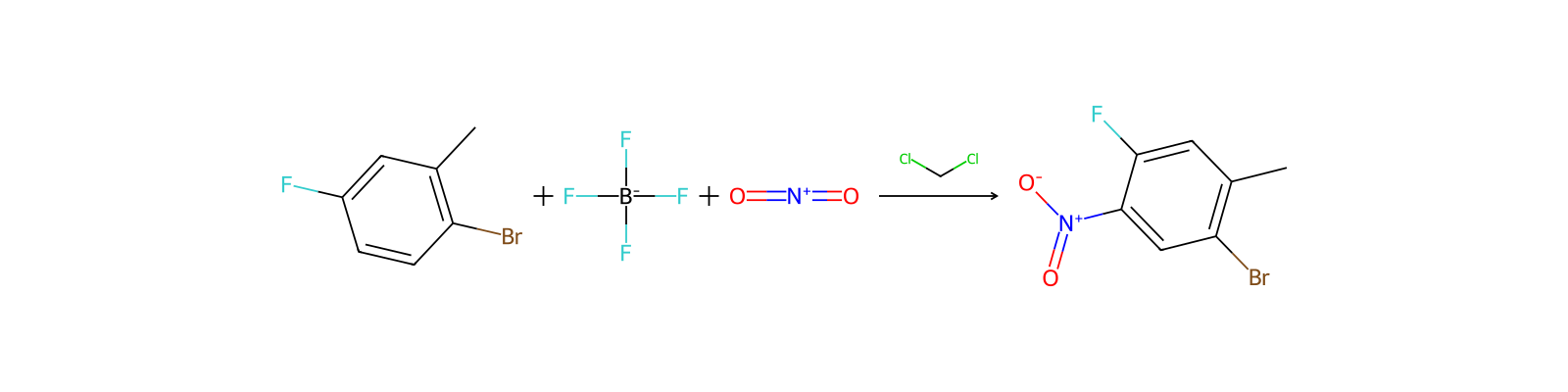
2-Bromo-5-fluorotoluene → 1-Bromo-4-fluoro-2-methyl-5-nitrobenzene

HRID 39195
Notes
Print preview

Reaction equation

HRID 39195 reaction equation
[Br:1][C:2]1[CH:7]=[CH:6][C:5]([F:8])=[CH:4][C:3]=1[CH3:9].F[B-](F)(F)F.[O:15]=[N+:16]=[O:17]>ClCCl>[Br:1][C:2]1[CH:7]=[C:6]([N+:16]([O-:17])=[O:15])[C:5]([F:8])=[CH:4][C:3]=1[CH3:9]
ParticipantsProcedureWorkupSources & evidenceReaction notes

Participants

4

Reactant 2

HCID 967432-Bromo-5-fluorotolueneHCID 11073463Nitronium tetrafluoroborate

Product 1

HCID 100369831-Bromo-4-fluoro-2-methyl-5-nitrobenzeneYield 96.4%

Reagents, catalysts & solvents 1

HCID 6344DichloromethaneSolvent

Procedure

To a stirred solution of 1-bromo-4-fluoro-2-methyl-benzene (15.0 g, 79.8 mmol) in dichloromethane (300 mL) was added nitronium tetrafluoroborate (11.7 g, 87.8 mmol) in portions at 0° C. The mixture was heated at reflux for 5 h and was then poured into ice water. The organic layer was separated and the aqueous phase was extracted with dichloromethane (100 mL×3). The combined organic layers were dried over anhydrous Na2SO4 and evaporated under reduced pressure to give crude 1-bromo-4-fluoro-2-methyl-5-nitrobenzene (18.0 g), which was used directly in the next step.

On this pageParticipantsProcedureWorkupSources & evidenceReaction notes

Workup

  1. temperatureThe mixture was heated
  2. temperatureat reflux for 5 h
  3. customThe organic layer was separated
  4. extractionthe aqueous phase was extracted with dichloromethane (100 mL×3)
  5. dry with materialThe combined organic layers were dried over anhydrous Na2SO4
  6. customevaporated under reduced pressure

Sources & evidence

ORD record
ord-5f407a25c01940e38dcf5cc645b3817a
Source dataset
uspto-grants-2013_09
DOI
10.6084/m9.figshare.5104873.v1
Patent number
US08524767B2

Reaction notes

Loading…