Reaction equation
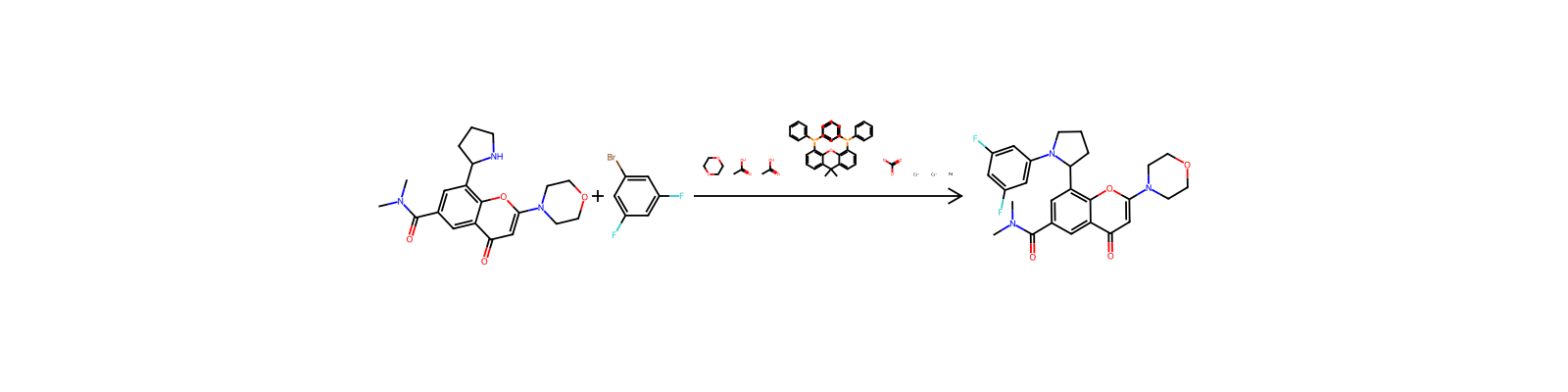
CN(C)C(=O)c1cc(C2CCCN2)c2oc(N3CCOCC3)cc(=O)c2c1.Fc1cc(F)cc(Br)c1>C1COCCO1.CC(=O)O.CC(=O)O.CC1(C)c2cccc(P(c3ccccc3)c3ccccc3)c2Oc2c(P(c3ccccc3)c3ccccc3)cccc21.O=C([O-])[O-].[Cs+].[Cs+].[Pd]>CN(C)C(=O)c1cc(C2CCCN2c2cc(F)cc(F)c2)c2oc(N3CCOCC3)cc(=O)c2c1Participants
Reactant 2


Product 1

Reagents, catalysts & solvents 4



Conditions
- Temperature
- 100 °C
Procedure
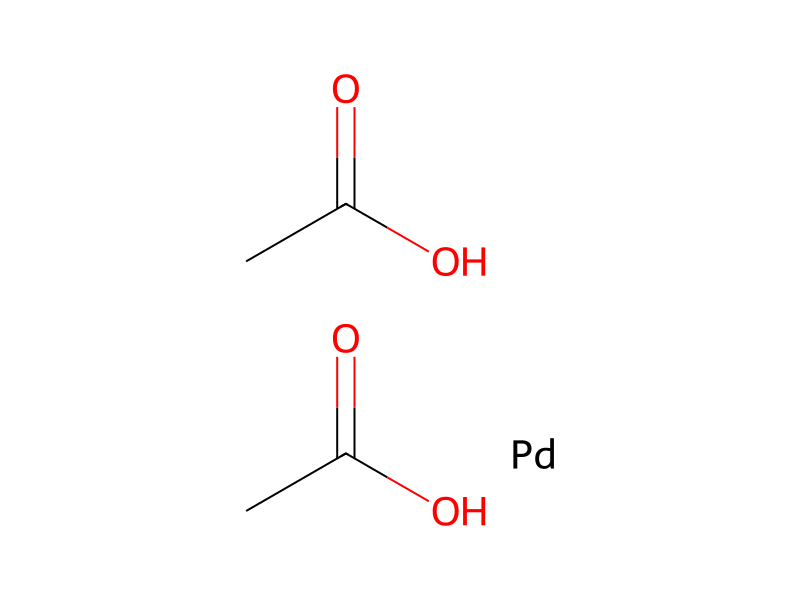
diacetoxypalladium (2.90 mg, 0.01 mmol) was added to a stirred mixture of N,N-dimethyl-2-morpholino-4-oxo-8-(pyrrolidin-2-yl)-4H-chromene-6-carboxamide (120 mg, 0.32 mmol), (9,9-dimethyl-9H-xanthene-4,5-diyl)bis(diphenylphosphine) (15.89 mg, 0.03 mmol), 1-bromo-3,5-difluorobenzene (46.5 µl, 0.40 mmol) and cesium carbonate (158 mg, 0.48 mmol) suspended in 1,4-dioxane (3184 µl). The resulting suspension was degased with argon and then stirred at 100 °C for 20 hours. The reaction mixture was allowed to cool to room temperature, The crude product was adsorbed on silica gel, the solvent was evaporated, and purified by flash chromatography on silica gel eluting with 0 to 10% methanol in ethyl acetate. The solvent was evaporated to dryness, the gum was triturated in Et2O/pentane to give a solid; the solid was filtered and dried to afford 8-(1-(3,5-difluorophenyl)pyrrolidin-2-yl)-N,N-dimethyl-2-morpholino-4-oxo-4H-chromene-6-carboxamide (80 mg, 51.2 %) as a white solid.
Sources & evidence
- ORD record
- ord-1563c8430590422cb033c9d23b6239c7
- Source dataset
- 750 AstraZeneca ELN dataset
- Original link
- View source
Linked notes
Loading…