Reaction equation

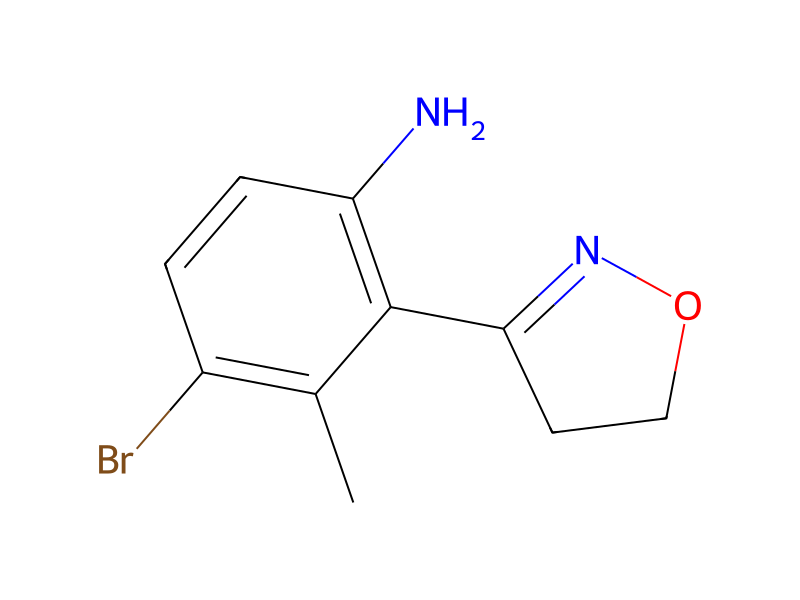
[O:1]1[CH2:5][CH2:4][C:3]([C:6]2[C:12]([CH3:13])=[CH:11][CH:10]=[CH:9][C:7]=2[NH2:8])=[N:2]1.C(=O)([O-])[O-].[K+].[K+].[Br-:20].[Br-].[Br-].C([N+](CCCC)(CCCC)CCCC)CCC.C([N+](CCCC)(CCCC)CCCC)CCC.C([N+](CCCC)(CCCC)CCCC)CCC>C(#N)C>[Br:20][C:11]1[CH:10]=[CH:9][C:7]([NH2:8])=[C:6]([C:3]2[CH2:4][CH2:5][O:1][N:2]=2)[C:12]=1[CH3:13]Participants
5




Procedure
30 g (170 mmol) of 2-(4,5-dihydroisoxazol-3-yl)-3-methylaniline are dissolved in 400 ml of acetonitrile, and 94 g (0.68 mol) of potassium carbonate are added. At temperatures <30° C., 84 g (174 mmol) of tetrabutylammonium tribromide are then added a little at a time, with vigorous stirring. For work-up, the solid is filtered off with suction and the solution is diluted with methylene chloride and extracted with water. The solvent is stripped off and the residue is then taken up again in methyl tert-butyl ether and washed twice with water. The organic phase is dried and concentrated.
Workup
- filtrationFor work-up, the solid is filtered off with suction
- additionthe solution is diluted with methylene chloride
- extractionextracted with water
- washwashed twice with water
- customThe organic phase is dried
- concentrationconcentrated
Sources & evidence
- ORD record
- ord-48185009ba5b4fda8f47291661fc6cdc
- Source dataset
- uspto-grants-2003_08
- Patent number
- US06608209B2
Linked notes
Loading…