HomeMCPWorkbenchSkills
HomeWorkbenchNotificationsMe
llms.txt · MCP GuidePrivacy Policy · Terms of Service · Supportv1.8.0
  1. Home
  2. /Reaction

Water → 2-(3,4-Dihydroxyphenyl)acetonitrile

HRID 401535
Notes
Print preview

Reaction equation

HRID 401535 reaction equation
[O:1]1[C:5]2[CH:6]=[CH:7][C:8]([CH2:10][C:11]#[N:12])=[CH:9][C:4]=2[O:3]C1.B(Br)(Br)Br.O>C(Cl)Cl>[OH:3][C:4]1[CH:9]=[C:8]([CH2:10][C:11]#[N:12])[CH:7]=[CH:6][C:5]=1[OH:1]
ParticipantsProcedureWorkupSources & evidenceReaction notes

Participants

5

Reactant 3

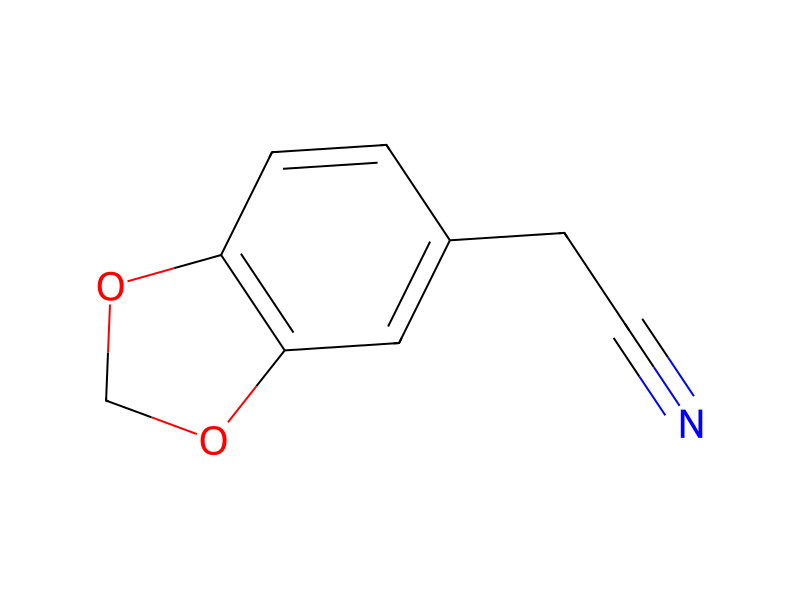
HCID 962WaterHCID 25134Boron tribromideHCID 781783,4-(Methylenedioxy)phenylacetonitrile

Product 1

HCID 109097272-(3,4-Dihydroxyphenyl)acetonitrileYield 54.1%

Reagents, catalysts & solvents 1

HCID 6344DichloromethaneSolvent

Procedure

To a solution of benzo[1,3]dioxol-5-yl-acetonitrile (0.50 g, 3.1 mmol) in CH2Cl2 (15 mL) was added dropwise BBr3 (0.78 g, 3.1 mmol) at −78° C. under N2. The mixture was slowly warmed to room temperature and stirred overnight. H2O (10 mL) was added to quench the reaction and the CH2Cl2 layer was separated. The aqueous phase was extracted with CH2Cl2 (2×7 mL). The combined organics were washed with brine, dried over Na2SO4 and purified by column chromatography on silica gel (Petroleum Ether/EtOAc 5:1) to give (3,4-dihydroxy-phenyl)-acetonitrile (0.25 g, 54%) as a white solid. 1H NMR (DMSO-d6, 400 MHz) δ 9.07 (s, 1H), 8.95 (s, 1H), 6.68-6.70 (m, 2H), 6.55 (dd, J=8.0, 2.0 Hz, 1H), 3.32 (s, 2H).

Workup

  1. customto quench
  2. customthe reaction
  3. customthe CH2Cl2 layer was separated
  4. extractionThe aqueous phase was extracted with CH2Cl2 (2×7 mL)
  5. washThe combined organics were washed with brine
  6. dry with materialdried over Na2SO4
  7. custompurified by column chromatography on silica gel (Petroleum Ether/EtOAc 5:1)

Sources & evidence

ORD record
ord-db38382a874e4a3abc5f2cdbce8c17a5
Source dataset
uspto-grants-2014_06
DOI
10.6084/m9.figshare.5104873.v1
Patent number
US08741933B2

Reaction notes

Loading…

On this pageParticipantsProcedureWorkupSources & evidenceReaction notes