Reaction equation
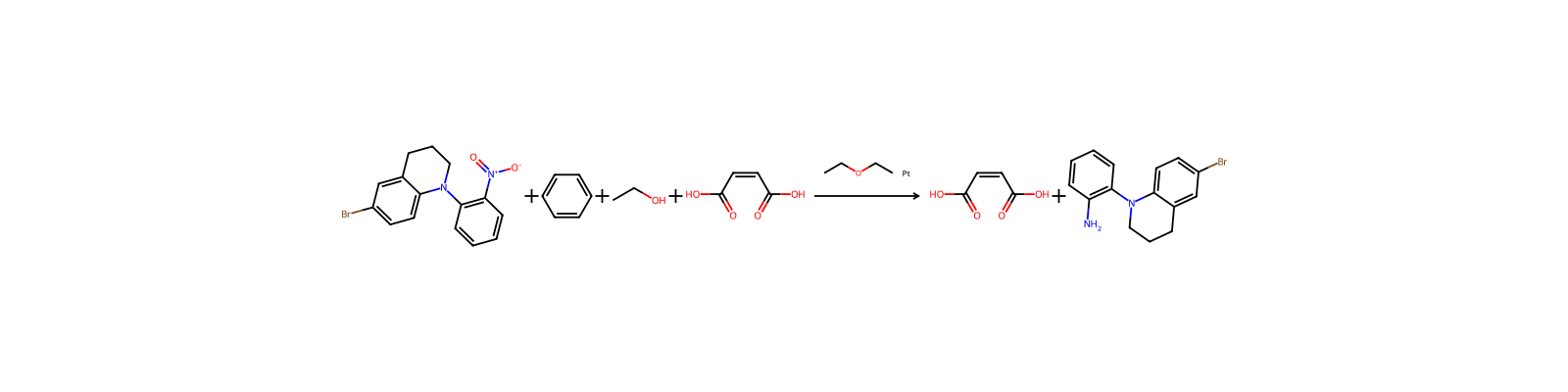
[Br:1][C:2]1[CH:3]=[C:4]2[C:9](=[CH:10][CH:11]=1)[N:8]([C:12]1[CH:17]=[CH:16][CH:15]=[CH:14][C:13]=1[N+:18]([O-])=O)[CH2:7][CH2:6][CH2:5]2.C1C=CC=CC=1.C(O)C.[C:30]([OH:37])(=[O:36])/[CH:31]=[CH:32]\[C:33]([OH:35])=[O:34]>CCOCC.[Pt]>[C:30]([OH:37])(=[O:36])/[CH:31]=[CH:32]\[C:33]([OH:35])=[O:34].[NH2:18][C:13]1[CH:14]=[CH:15][CH:16]=[CH:17][C:12]=1[N:8]1[C:9]2[C:4](=[CH:3][C:2]([Br:1])=[CH:11][CH:10]=2)[CH2:5][CH2:6][CH2:7]1Participants
Reactant 4




Product 1

Reagents, catalysts & solvents 2


Procedure
A Parr hydrogenation bottle was charged with 6-bromo-(2-nitrophenyl)-1,2,3,4-tetrahydroquinoline (16.7 g, 0.050 mole), 1% platinum-on-carbon (1 g), benzene (100 ml) and ethanol (100 ml). The mixture was shaken under an initial hydrogen pressure of 58 psi until uptake ceased. The mixture was then filtered to remove the catalyst and the filtrate was concentrated under vacuum. The residue was taken up in hot ether (150 ml), filtered, and the filtrate was treated with a hot solution of maleic acid (6.4 g, 0.055 mole) in ether (500 ml). The solution was boiled down to about 300 ml and allowed to cool. The supernatant was decanted from an oil, which separated. The supernatant was concentrated and the process was repeated several times to give 11.4 g (55%) of product. Recrystallization from ethyl acetate afforded the analytical sample, mp 113°-116° C.
Workup
- filtrationThe mixture was then filtered
- customto remove the catalyst
- concentrationthe filtrate was concentrated under vacuum
- filtrationfiltered
- temperatureto cool
- customThe supernatant was decanted from an oil, which
- customseparated
- concentrationThe supernatant was concentrated
Sources & evidence
- ORD record
- ord-2b04d48d5e5a4e3d9c091e3fa05cb57e
- Source dataset
- uspto-grants-1988_02
- Patent number
- US04723007
Linked notes
Loading…