Reaction equation

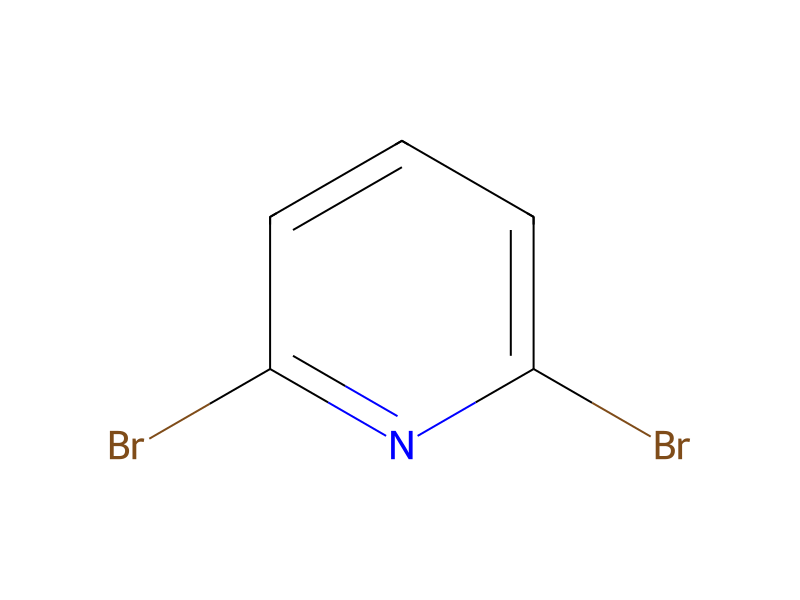
Br[C:2]1[CH:7]=[CH:6][CH:5]=[C:4]([Br:8])[N:3]=1.C([Li])CCC.[C:14]([O:18][C:19]([N:21]1[CH2:26][CH2:25][CH:24]([C:27](N(OC)C)=[O:28])[CH2:23][CH2:22]1)=[O:20])([CH3:17])([CH3:16])[CH3:15].[OH-].[Na+]>ClCCl.CCCCCC>[Br:8][C:4]1[CH:5]=[CH:6][CH:7]=[C:2]([C:27]([CH:24]2[CH2:25][CH2:26][N:21]([C:19]([O:18][C:14]([CH3:17])([CH3:16])[CH3:15])=[O:20])[CH2:22][CH2:23]2)=[O:28])[N:3]=1Participants
Reactant 4



Product 1

Reagents, catalysts & solvents 2


Conditions
- Temperature
- -78 °C
Procedure
Dissolve 2,6-dibromopyridine (3.6 g, 15.3 mmol) in anhydrous dichloromethane (90 mL) under nitrogen atmosphere. Cool the reaction mixture to −78° C. Add a solution of n-butyl lithium in hexane very slowly via a syringe (1.6 M, 10.5 mL, 16.9 mmol). After the addition is complete, stir the reaction at −78° C. for 1 hr. Add a solution of 4-(methoxy-methyl-aminocarbonyl)-piperidine-1-carboxylic acid tert-butyl ester (2 g, 7.3 mmol) in anhydrous dichloromethane (10 mL) dropwise to the reaction mixture. Stir the reaction at −78° C. for 2 hrs., then allow it to slowly warm to room temperature overnight. Quench the reaction with 0.1 N aqueous NaOH. Dilute the solution with dichloromethane (100 mL), transfer into a separation funnel and shake with 0.1 N NaOH (60 mL). Separate the organic layer and dry it over anhydrous sodium sulfate. Evaporate the solvent under reduced pressure. Further purify the residue by chromatography on silica gel column (10%-30% ethyl acetate/hexane) to obtain 2-bromo-6-(1-t-butoxycarbonylpiperidin-4-ylcarbonyl)-pyridine (2.7 g, quantitative yield). Mass spectrum (ion spray): m/z 370 (M+1).
Workup
- additionAfter the addition
- customthe reaction at −78° C. for 1 hr
- stirringStir
- customthe reaction at −78° C. for 2 hrs
- temperatureto slowly warm to room temperature overnight
- customQuench
- customthe reaction with 0.1 N aqueous NaOH
- customSeparate the organic layer
- dry with materialdry it over anhydrous sodium sulfate
- customEvaporate the solvent under reduced pressure
- customFurther purify the residue by chromatography on silica gel column (10%-30% ethyl acetate/hexane)
Sources & evidence
- ORD record
- ord-941d87c119f948faa70566f7948efbe9
- Source dataset
- uspto-grants-2014_06
- Patent number
- US08748459B2
Linked notes
Loading…