Reaction equation
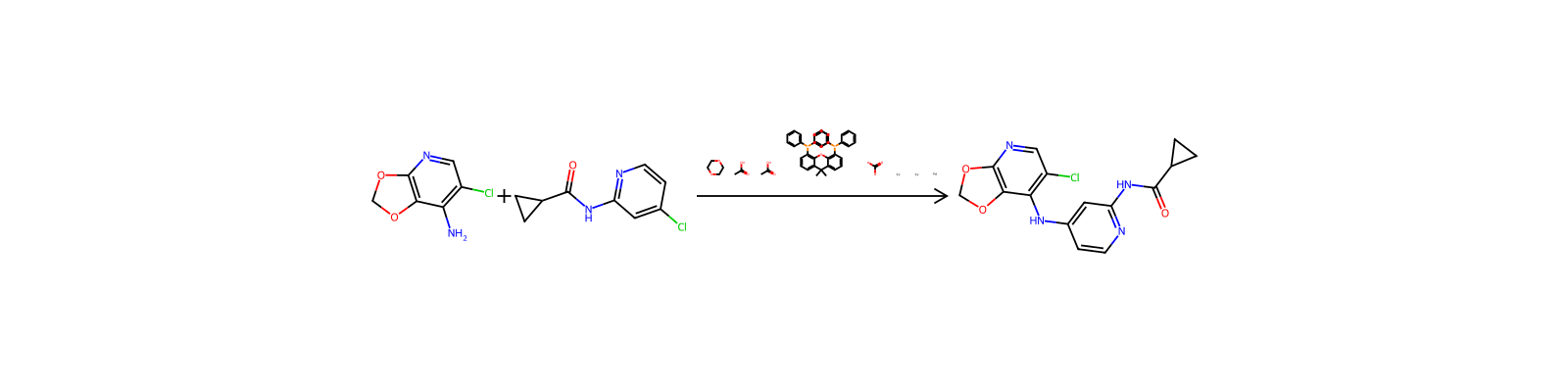
Nc1c(Cl)cnc2c1OCO2.O=C(Nc1cc(Cl)ccn1)C1CC1>C1COCCO1.CC(=O)O.CC(=O)O.CC1(C)c2cccc(P(c3ccccc3)c3ccccc3)c2Oc2c(P(c3ccccc3)c3ccccc3)cccc21.O=C([O-])[O-].[Cs+].[Cs+].[Pd]>O=C(Nc1cc(Nc2c(Cl)cnc3c2OCO3)ccn1)C1CC1Participants
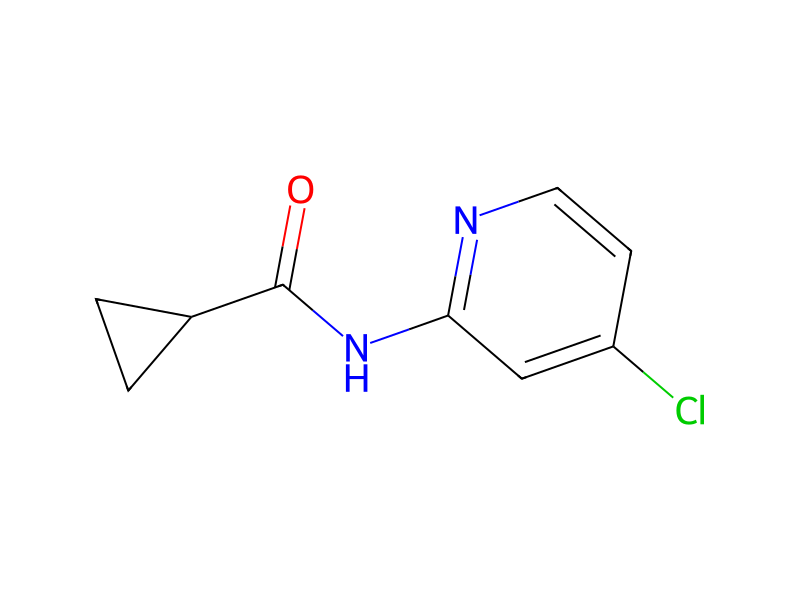
Reactant 2
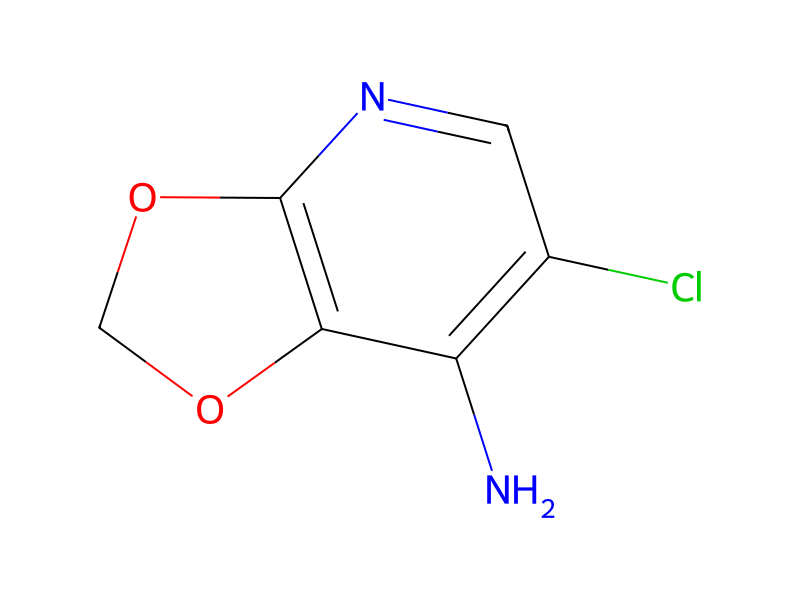
Product 1

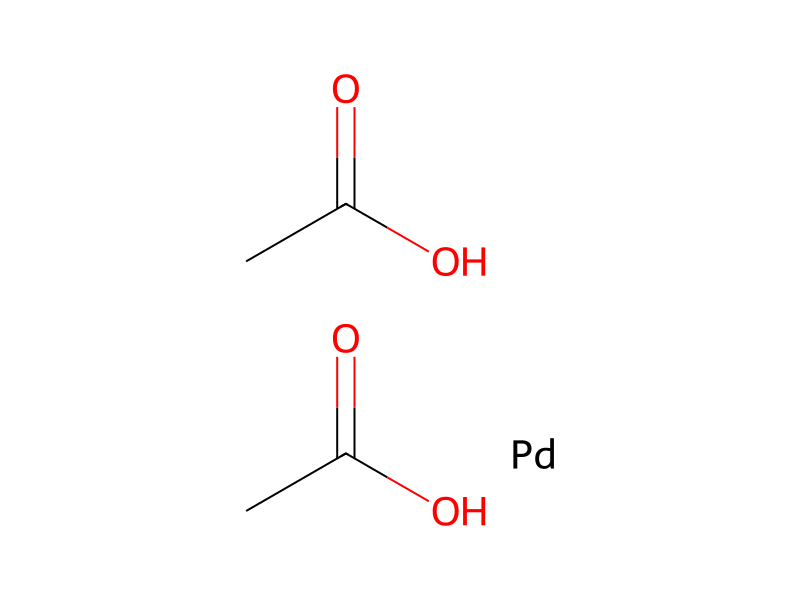
Reagents, catalysts & solvents 4



Conditions
- Temperature
- 150 °C
Procedure
N-(4-chloropyridin-2-yl)cyclopropanecarboxamide (0.8 g, 4.07 mmol), 6-chloro-[1,3]dioxolo[4,5-b]pyridin-7-amine (0.702 g, 4.07 mmol), (9,9-dimethyl-9H-xanthene-4,5-diyl)bis(diphenylphosphine) (0.282 g, 0.49 mmol), diacetoxypalladium (0.046 g, 0.20 mmol) and cesium carbonate (2.65 g, 8.14 mmol) were suspended in 1,4-dioxane (15 mL) and sealed into a microwave tube. The reaction was heated to 150 °C for 30 minutes in the microwave reactor and cooled to RT. The reaction mixture was evaporated and partitioned between EtOAc (50 mL) and water (50 mL). The mixture was filtered and the organic layer was dried over MgSO4, filtered and evaporated to afford crude product. The crude product was purified by flash silica chromatography, elution gradient 0 to 5% MeOH in DCM. Pure fractions were evaporated to dryness to afford N-(4-(6-chloro-[1,3]dioxolo[4,5-b]pyridin-7-ylamino)pyridin-2-yl)cyclopropanecarboxamide (0.384 g, 28.4 %) as a white solid. Impure fractions were combined and purified by flash silica chromatography, elution gradient 0 to 100% EtOAc in isohexane. Pure fractions were evaporated to dryness to afford more crude material. This material was triturated with DCM to afford a second batch of the material.
Sources & evidence
- ORD record
- ord-53e4c550d2a942e0b2b88b16dae21b0b
- Source dataset
- 750 AstraZeneca ELN dataset
- Original link
- View source
Linked notes
Loading…