Reaction equation
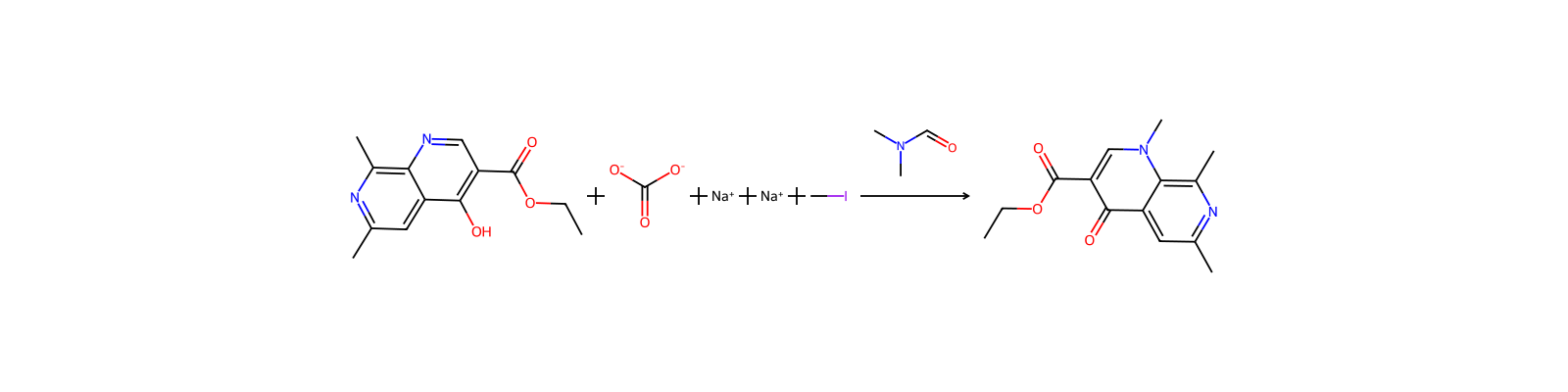
[OH:1][C:2]1[C:11]2[C:6](=[C:7]([CH3:13])[N:8]=[C:9]([CH3:12])[CH:10]=2)[N:5]=[CH:4][C:3]=1[C:14]([O:16][CH2:17][CH3:18])=[O:15].[C:19]([O-])([O-])=O.[Na+].[Na+].IC>CN(C=O)C>[CH3:19][N:5]1[C:6]2[C:11](=[CH:10][C:9]([CH3:12])=[N:8][C:7]=2[CH3:13])[C:2](=[O:1])[C:3]([C:14]([O:16][CH2:17][CH3:18])=[O:15])=[CH:4]1Participants
5




Procedure
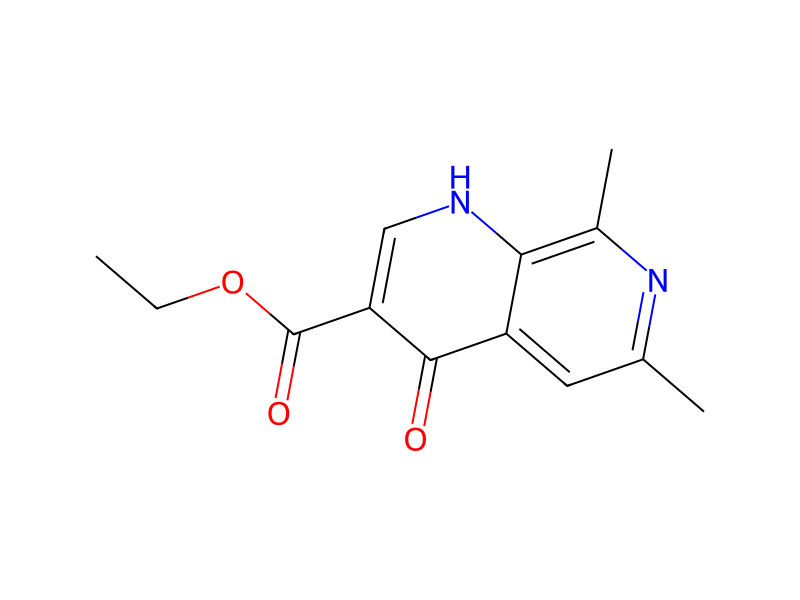
Ethyl 4-hydroxy-6,8-dimethyl-1,7-naphthyridine-3-carboxylate (Preparation 47, 460 mg) is dissolved in DMF (30 mL) and treated with Na2CO3 (396 mg). Iodomethane (0.3 mL) is slowly added to the mixture, and it is then heated to reflux for 1 h. The reaction mixture is cooled to room temperature, quenched with water (20 mL) and extracted with CH2Cl2 (50 mL). The organic layer is separated, dried (MgSO4), and concentrated in vacuo. The residue is purified by silica gel column chromatography (5% methanol/CH2Cl2) to give 100 mg (21%) of the title compound as a white solid. Physical characteristics: MS (ESI+) m/z 261 (M+H)+; 1H NMR (DMSO) δ 8.61, 7.78, 4.23, 4.18, 3.00, 2.56, 1.28.
Workup
- temperatureis then heated
- temperatureto reflux for 1 h
- customquenched with water (20 mL)
- extractionextracted with CH2Cl2 (50 mL)
- customThe organic layer is separated
- dry with materialdried (MgSO4)
- concentrationconcentrated in vacuo
- customThe residue is purified by silica gel column chromatography (5% methanol/CH2Cl2)
Sources & evidence
- ORD record
- ord-8a9eac3c2e3c488289e7de5278ae5083
- Source dataset
- uspto-grants-2003_05
- Patent number
- US06559145B2
Linked notes
Loading…