HomeMCPWorkbenchSkills
HomeWorkbenchNotificationsMe
llms.txt · MCP GuidePrivacy Policy · Terms of Service · Supportv1.8.3
  1. Home
  2. /Reaction

Toluene → 5-(3-Cyanophenyl)-2,3-diphenylpyrazine

HRID 423175
Print

Reaction equation

HRID 423175 reaction equation
[C:1]1([C:7]2[C:12]([C:13]3[CH:18]=[CH:17][CH:16]=[CH:15][CH:14]=3)=[N:11][C:10](Cl)=[CH:9][N:8]=2)[CH:6]=[CH:5][CH:4]=[CH:3][CH:2]=1.[C:20]([C:22]1[CH:23]=[C:24](B(O)O)[CH:25]=[CH:26][CH:27]=1)#[N:21].C1(C)C=CC=CC=1.C(=O)([O-])[O-].[K+].[K+]>ClCCl.O.C(O)C>[C:20]([C:22]1[CH:27]=[C:26]([C:10]2[N:11]=[C:12]([C:13]3[CH:18]=[CH:17][CH:16]=[CH:15][CH:14]=3)[C:7]([C:1]3[CH:6]=[CH:5][CH:4]=[CH:3][CH:2]=3)=[N:8][CH:9]=2)[CH:25]=[CH:24][CH:23]=1)#[N:21]
ParticipantsProcedureWorkupSources & evidenceReaction notes

Participants

8

Reactant 4

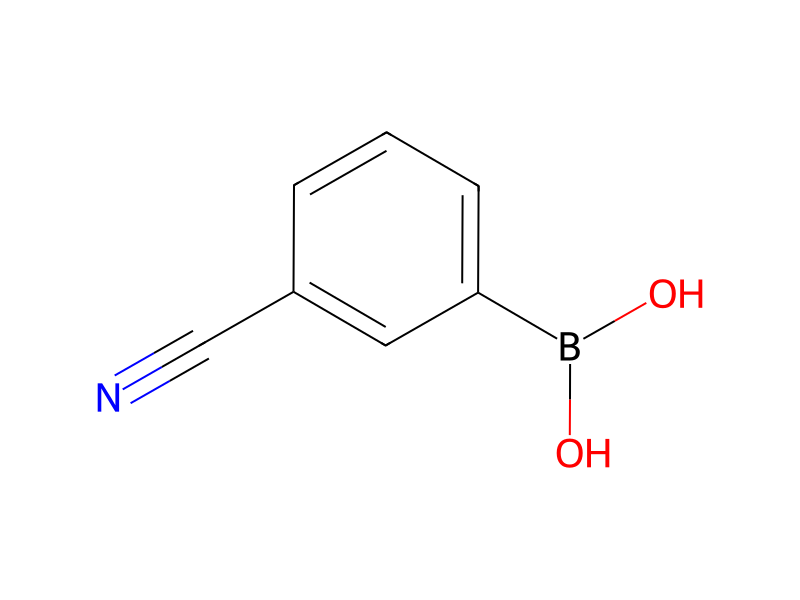
HCID 1140TolueneHCID 11430Potassium CarbonateHCID 27343253-Cyanophenylboronic acidHCID 36544935-Chloro-2,3-Diphenylpyrazine

Product 1

HCID 666728855-(3-Cyanophenyl)-2,3-diphenylpyrazineYield 42%

Reagents, catalysts & solvents 3

HCID 702
Ethanol
Solvent
HCID 962WaterSolvent2×
HCID 6344DichloromethaneSolvent

Procedure

First, 1.02 g of 2,3-diphenyl-5-chloropyrazine, 0.62 g of 3-cyanophenylboronic acid, 0.15 g of tetrakis triphenylphosphine palladium(0) (abbreviation: Pd(PPh3)4), 10 mL of toluene, 1.5 mL of ethanol, 1.16 g of potassium carbonate, 4.2 mL of water were put in an eggplant-type flask with a reflux pipe, and the atmosphere in the flask was substituted with argon. Then, irradiation with microwave (2.45 GHz, 100 W to 150 W) was performed for 45 minutes to cause a reaction. Water was added to this mixture and dichloromethane was used as an extraction solvent, so that an organic layer was extracted. The obtained organic layer was dried with anhydrous magnesium sulfate. After the drying, the solution was filtrated. After a solvent of this solution was distilled off, the residue obtained by the distillation was purified by silica gel column chromatography which uses a mixture solution of dichloromethane and ethyl acetate as a developing solvent to obtain a white powdered solid in a yield of 42%. Note that the irradiation with a microwave was performed using a microwave synthesis system (Discover, produced by CEM Corporation). A synthesis scheme of Step 1 is shown by the following (a-1).


Workup

  1. customThen, irradiation with microwave (2.45 GHz, 100 W to 150 W)
  2. customa reaction
  3. extractionwas extracted
  4. dry with materialThe obtained organic layer was dried with anhydrous magnesium sulfate
  5. filtrationAfter the drying, the solution was filtrated
  6. distillationAfter a solvent of this solution was distilled off
  7. customthe residue obtained by the distillation
  8. customwas purified by silica gel column chromatography which
  9. customto obtain a white powdered solid in a yield of 42%
  10. customNote that the irradiation with a microwave
  11. customa microwave synthesis system (Discover, produced by CEM Corporation)
  12. customA synthesis scheme of Step 1

Sources & evidence

ORD record
ord-da8a32ebe944490998d46346327e4db4
Source dataset
uspto-grants-2012_01
DOI
10.6084/m9.figshare.5104873.v1
Patent number
US08101755B2

Reaction notes

On this pageParticipantsProcedureWorkupSources & evidenceReaction notes