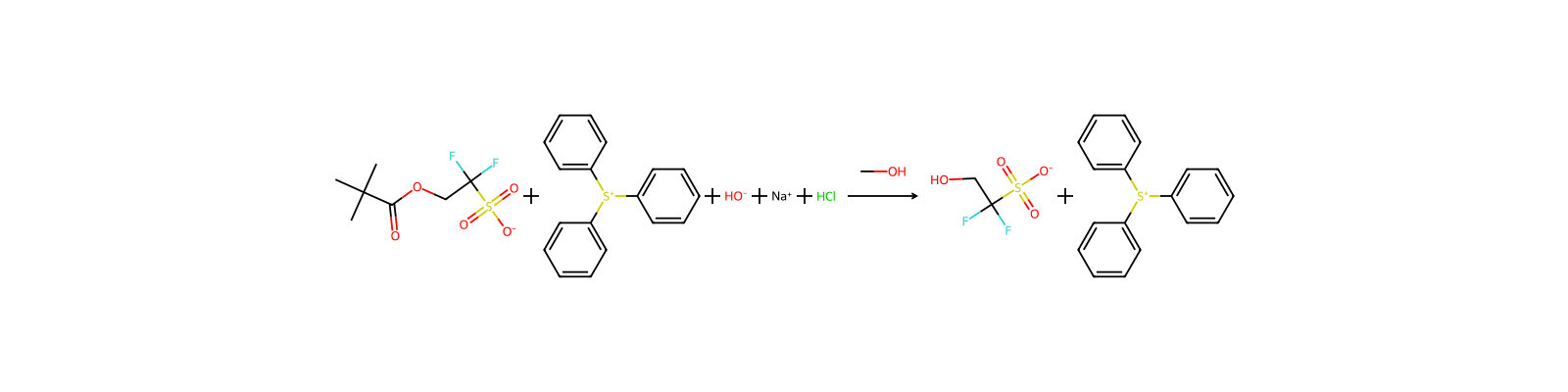
C([O:7][CH2:8][C:9]([F:15])([F:14])[S:10]([O-:13])(=[O:12])=[O:11])(=O)C(C)(C)C.[C:16]1([S+:22]([C:29]2[CH:34]=[CH:33][CH:32]=[CH:31][CH:30]=2)[C:23]2[CH:28]=[CH:27][CH:26]=[CH:25][CH:24]=2)[CH:21]=[CH:20][CH:19]=[CH:18][CH:17]=1.[OH-].[Na+].Cl>CO>[F:14][C:9]([F:15])([S:10]([O-:13])(=[O:12])=[O:11])[CH2:8][OH:7].[C:29]1([S+:22]([C:16]2[CH:17]=[CH:18][CH:19]=[CH:20][CH:21]=2)[C:23]2[CH:28]=[CH:27][CH:26]=[CH:25][CH:24]=2)[CH:30]=[CH:31][CH:32]=[CH:33][CH:34]=1In 760 g of methanol was dissolved 243.5 g (0.48 mole) of triphenylsulfonium 2-(pivaloyloxy)-1,1-difluoroethane-sulfonate. To this solution under ice cooling, an aqueous sodium hydroxide solution (40 g sodium hydroxide in 120 g water) was added dropwise at a temperature below 5° C. The reaction solution was allowed to mature at room temperature for 8 hours, and dilute hydrochloric acid (99.8 g 12N hydrochloric acid in 200 g water) was added thereto at a temperature below 10° C. to quench the reaction. The methanol was distilled off in vacuum. To the residue was added 1,000 g of dichloromethane. The organic layer was washed three times with 30 g of saturated saline and concentrated. Diisopropyl ether, 1 L, was added to the concentrate for crystallization. The crystals were filtered and dried, obtaining the target compound (PAG1), 187 g (purity 78%, net yield 78%). PAG1 has the following structure.