Reaction equation

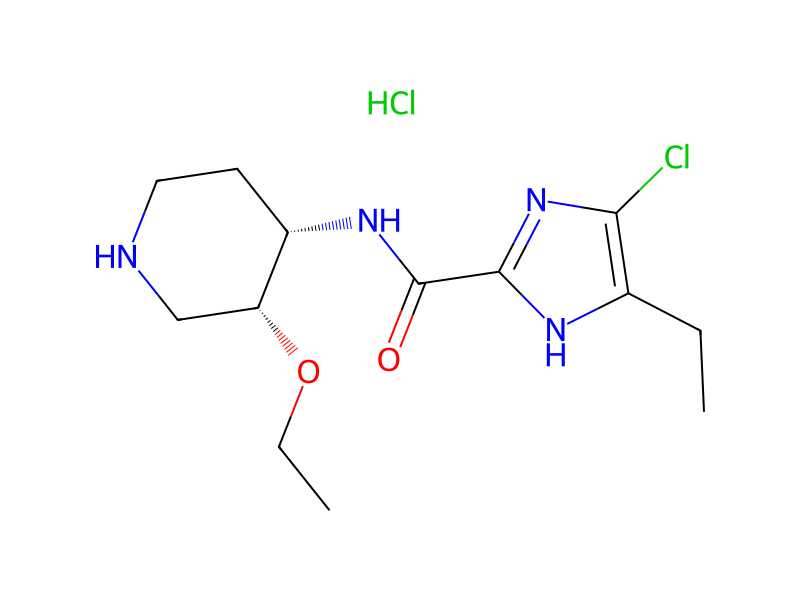
Cl.[Cl:2][C:3]1[N:4]=[C:5]([C:10]([NH:12][C@H:13]2[CH2:18][CH2:17][NH:16][CH2:15][C@H:14]2[O:19][CH2:20][CH3:21])=[O:11])[NH:6][C:7]=1[CH2:8][CH3:9].Cl[C:23]1[N:28]=[CH:27][CH:26]=[CH:25][N:24]=1.C(=O)([O-])[O-].[Na+].[Na+]>CN(C=O)C>[Cl:2][C:3]1[N:4]=[C:5]([C:10]([NH:12][C@H:13]2[CH2:18][CH2:17][N:16]([C:23]3[N:28]=[CH:27][CH:26]=[CH:25][N:24]=3)[CH2:15][C@H:14]2[O:19][CH2:20][CH3:21])=[O:11])[NH:6][C:7]=1[CH2:8][CH3:9]Participants
5
Reactant 3


Product 1

Reagents, catalysts & solvents 1

Procedure
cis(±)-4-Chloro-N-(3-ethoxypiperidin-4-yl)-5-ethyl-1H-imidazole-2-carboxamide hydrochloride obtained in Example (131a) (100 mg, 0.297 mmol), 2-chloropyrimidine (51 mg, 0.45 mmol) and sodium carbonate (157 mg, 1.48 mmol) were suspended in DMF (1 mL). The suspension was subjected to the same operation as in Example (131b) to obtain 25.1 mg of the title compound as a white solid (22%).
Sources & evidence
- ORD record
- ord-346ba7a62f974cd7a72fec0a2a24d51d
- Source dataset
- uspto-grants-2013_09
- Patent number
- US08536197B2
Linked notes
Loading…