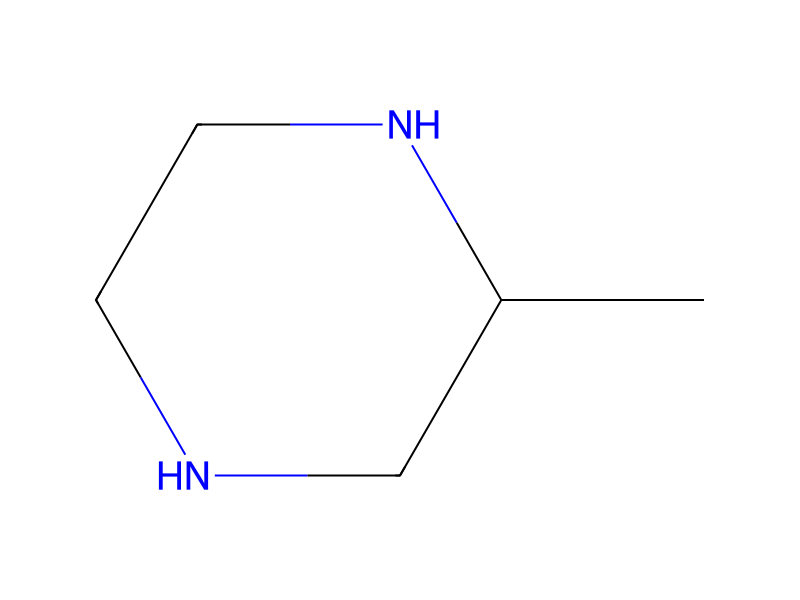
2-Methylpiperazine → HCID 21473369, compound
Reaction equation

[CH2:1]([N:3]1[C:12]2[C:7](=[CH:8][C:9]([F:18])=[C:10](F)[C:11]=2[O:13][CH:14]([F:16])[F:15])[C:6](=[O:19])[C:5]([C:20]([OH:22])=[O:21])=[CH:4]1)[CH3:2].[CH3:23][CH:24]1[CH2:29][NH:28][CH2:27][CH2:26][NH:25]1>N1C=CC=CC=1>[CH2:1]([N:3]1[C:12]2[C:7](=[CH:8][C:9]([F:18])=[C:10]([N:28]3[CH2:27][CH2:26][NH:25][CH:24]([CH3:23])[CH2:29]3)[C:11]=2[O:13][CH:14]([F:16])[F:15])[C:6](=[O:19])[C:5]([C:20]([OH:22])=[O:21])=[CH:4]1)[CH3:2]Participants
4
Reactant 2

Product 1

Reagents, catalysts & solvents 1

Procedure
In 60 ml of pyridine were dissolved 3.19 g (0.01 mole) of 1-ethyl-6,7-difluoro-8-difluoromethoxy-1,4-dihydro-4-oxoquinoline-3-carboxylic acid and 3.0 g (0.03 mole) of 2methylpiperazine, and the mixture was stirred at 105° to 110° C. for 2 hours. Then, the solvent was removed under reduced pressure. Water was added to the residue, and crystals precipitated were collected by filtration, washed with water and ethanol, and dried to obtain 3.23 g of 1-ethyl-6-fluoro-8-difluoromethoxy-7-(3-methylpiperazin-1-Yl)-1,4-dihydro-4-oxoquinoline-3-carboxylic acid as pale yellow powder.