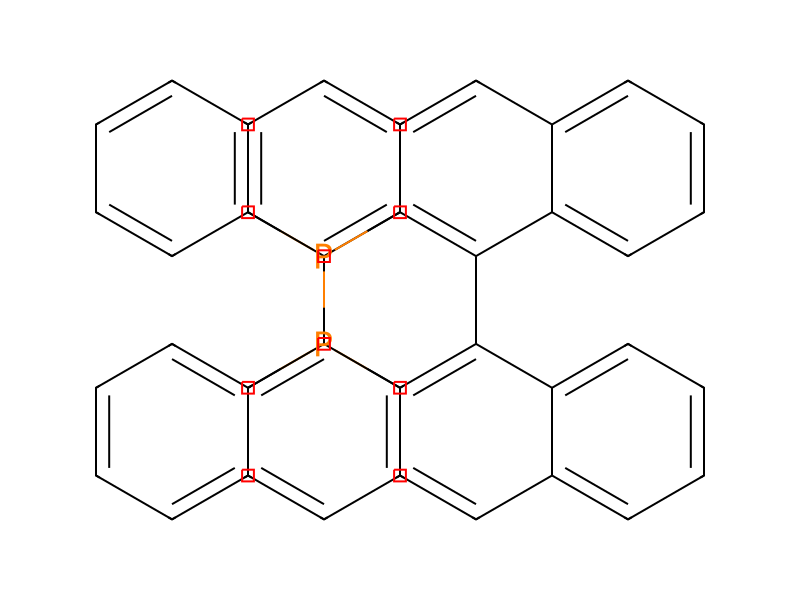
C1C=CC(P(C2C(C3C(P(C4C=CC=CC=4)C4C=CC=CC=4)=CC=C4C=3C=CC=C4)=C3C(C=CC=C3)=CC=2)C2C=CC=CC=2)=CC=1.Cl[C:48]1[C:57]([Cl:58])=[N:56][C:55]2[C:50](=[CH:51][CH:52]=[CH:53][CH:54]=2)[N:49]=1.[C:59]1([NH2:69])[C:68]2[C:63](=[CH:64][CH:65]=[CH:66][CH:67]=2)[CH:62]=[CH:61][CH:60]=1.CC(C)([O-])C.[K+]>C([O-])(=O)C.[Pd+2].C([O-])(=O)C>[Cl:58][C:57]1[C:48]([NH:69][C:59]2[C:68]3[C:63](=[CH:64][CH:65]=[CH:66][CH:67]=3)[CH:62]=[CH:61][CH:60]=2)=[N:49][C:50]2[C:55]([N:56]=1)=[CH:54][CH:53]=[CH:52][CH:51]=2BINAP (93.3 mg, 0.15 mmol) and palladium acetate (22.6 mg, 0.1 mmol) were dissolved in dry xylenes (50 mL) and stirred for 10 min in an inert atmosphere of nitrogen. 2,3-Dichloroquinoxaline (1.99 g, 10 mmol), 1-naphthylamine (1.50 g, 10.5 mmol) and potassium tert-butoxide (1.34 g, 12 mmol) were the added to the reaction mixture which was heated for 22 h under reflux. After cooling to room-temperature, the reaction mixture was filtered and inorganic precipitate washed with dichloromethane (3×50 mL). Removal of the solvent in vacuo results in a residue which was purified using silica gel chromatography (hexanes/EtOAc 9:1). Compound 2c was isolated as yellow-orange crystals, mp=157-159° C. Yield 33%. TLC Rf=0.45 (hexanes/EtOAc 3:1). HPLC/MS: [M+H]+ m/z 306. 1H NMR (CDCl3, 600 MHz): δ 7.50 (td, J=7.2 Hz, 1.2 Hz, 1H), 7.56-7.63 (m, 4H), 7.74 (d, J=8.4 Hz, 1H), 7.78 (dd, J=8.4 Hz, 1.2 Hz, 1H), 7.89 (dd, J=8.4 Hz, 1.2 Hz, 1H), 7.90 (d, J=8.4 Hz, 1H), 7.99-8.04 (m, 2H), 8.54 (d, J=7.2 Hz, 1H). 13C NMR (CDCl3, 150 MHz): δ 118.62, 120.31, 125.01, 125.85, 126.10, 126.26, 126.45, 126.74, 126.79, 127.89, 129.01, 130.42, 133.25, 134.26, 137.25, 138.12, 140.59, 145.71. HRMS: Calcd. for C18H13ClN3 [M+H]+ m/z 306.0793, Observed 306.0786.
Loading…