HomeMCPWorkbenchSkills
HomeWorkbenchNotificationsMe
llms.txt · MCP GuidePrivacy Policy · Terms of Service · Supportv1.8.3
  1. Home
  2. /Reaction

Sodium Carbonate → 2-[5-(4-Amino-3-nitro-5-tetrahydrofuran-2-yl-phenyl)pyrimidin-2-yl]propan-2-ol

HRID 447265
Print

Reaction equation

HRID 447265 reaction equation
Br[C:2]1[CH:7]=[C:6]([CH:8]2[CH2:12][CH2:11][CH2:10][O:9]2)[C:5]([NH:13]C(=O)C(F)(F)F)=[C:4]([N+:20]([O-:22])=[O:21])[CH:3]=1.CC1(C)C(C)(C)OB([C:31]2[CH:32]=[N:33][C:34]([C:37]([OH:40])([CH3:39])[CH3:38])=[N:35][CH:36]=2)O1.C(=O)([O-])[O-].[Na+].[Na+].O1CCOCC1>CCOC(C)=O.O.ClCCl.Cl[Pd]Cl.C1(P(C2C=CC=CC=2)[C-]2C=CC=C2)C=CC=CC=1.[C-]1(P(C2C=CC=CC=2)C2C=CC=CC=2)C=CC=C1.[Fe+2]>[NH2:13][C:5]1[C:6]([CH:8]2[CH2:12][CH2:11][CH2:10][O:9]2)=[CH:7][C:2]([C:31]2[CH:32]=[N:33][C:34]([C:37]([OH:40])([CH3:39])[CH3:38])=[N:35][CH:36]=2)=[CH:3][C:4]=1[N+:20]([O-:22])=[O:21]
ParticipantsProcedureWorkupSources & evidenceReaction notes

Participants

8

Reactant 4

HCID 10340Sodium Carbonate2×HCID 312751,4-DioxaneHCID 665203402-[5-(4,4,5,5-Tetramethyl-1,3,2-dioxaborolan-2-yl)pyrimidin-2-yl]propan-2-olHCID 71551840N-(4-bromo-2-nitro-6-tetrahydrofuran-2-yl-phenyl)-2,2,2-trifluoro-acetamide

Product 1

HCID 681081992-[5-(4-Amino-3-nitro-5-tetrahydrofuran-2-yl-phenyl)pyrimidin-2-yl]propan-2-ol

Reagents, catalysts & solvents 3

HCID 178418807HCID 178418807, compoundCatalystHCID 962WaterSolventHCID 8857Ethyl AcetateSolvent

Procedure

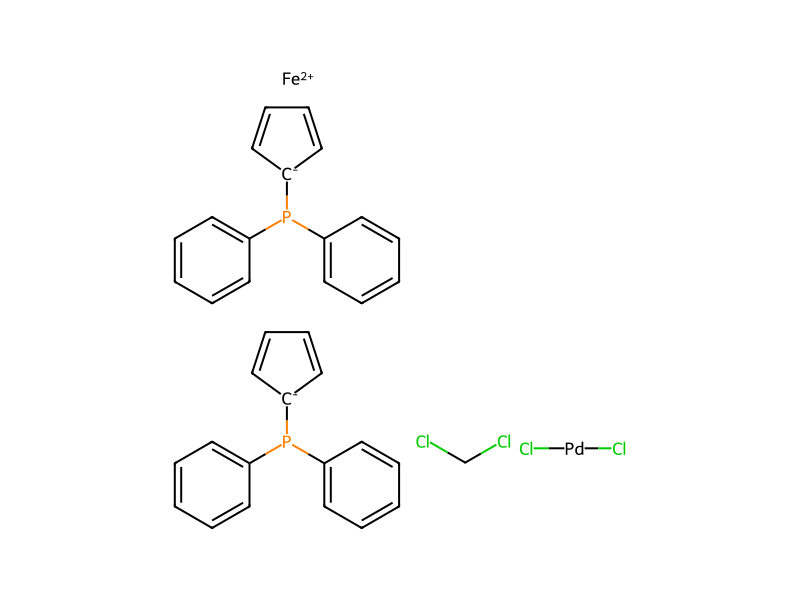
N-(4-Bromo-2-nitro-6-tetrahydrofuran-2-yl-phenyl)-2,2,2-trifluoro-acetamide (6) (19.00 g, 49.59 mmol), 2-[5-(4,4,5,5-tetramethyl-1,3,2-dioxaborolan-2-yl)pyrimidin-2-yl]propan-2-ol (7) (14.41 g, 54.55 mmol), aqueous 2.7 M sodium carbonate (73.48 mL, 198.4 mmol), and 1,4-dioxane (190 mL, Sigma-Aldrich 360481) were mixed. A stream of nitrogen was bubbled through the stirring mixture for 40 minutes, followed by addition of 1,1′-bis(diphenylphosphino)ferrocene dichloropalladium dichloromethane adduct (2.025 g, 2.480 mmol, Strem 460450). The reaction mixture was stirred at reflux under N2 for 7 hrs, added another 50 mL of saturated aqueous sodium carbonate, and refluxed for another 16 hrs. The reaction mixture was allowed to cool, then diluted with EtOAc (500 mL) and water (200 mL). The layers were separated and the aqueous phase extracted with EtOAc (200 mL). The combined organic phase was washed with water (500 mL), brine (500 mL), dried over Na2SO4, filtered through a Florisil® plug, and concentrated on a rotary evaporator to give crude (8) as an orange oil. Purified by ISCO silica gel chromatography eluting with 20-90% EtOAc/hexane to give (8) as an orange solid (15.00 g, 81-88% purity). LCMS (C18 column eluting with 10-90% CH3CN/water gradient over 5 minutes with formic acid modifier) M+1: 345.35 (2.68 min). 1H NMR (300 MHz, CDCl3) δ 8.88 (s, 2H), 8.36 (d, J=2.2 Hz, 1H), 7.56 (d, J=2.1 Hz, 1H), 7.09 (s, 2H), 4.92 (t, J=7.2 Hz, 1H), 4.62 (s, 1H), 4.20-4.11 (m, 1H), 4.03-3.94 (m, 1H), 2.39-2.26 (m, 1H), 2.23-2.08 (m, 3H), 1.64 (s, 6H) ppm.


Workup

  1. customA stream of nitrogen was bubbled through the stirring mixture for 40 minutes
  2. temperatureat reflux under N2 for 7 hrs
  3. temperaturerefluxed for another 16 hrs
  4. temperatureto cool
  5. customThe layers were separated
  6. extractionthe aqueous phase extracted with EtOAc (200 mL)
  7. washThe combined organic phase was washed with water (500 mL), brine (500 mL)
  8. dry with materialdried over Na2SO4
  9. filtrationfiltered through a Florisil® plug
  10. concentrationconcentrated on a rotary evaporator

Sources & evidence

ORD record
ord-4d1fe72d54364a51855f96f83145cf31
Source dataset
uspto-grants-2013_07
DOI
10.6084/m9.figshare.5104873.v1
Patent number
US08481552B2

Reaction notes

On this pageParticipantsProcedureWorkupSources & evidenceReaction notes