Reaction equation

[Br:1][C:2]1[CH:7]=[CH:6][C:5]([OH:8])=[CH:4][CH:3]=1.[N+:9]([C:12]1[CH:17]=[CH:16][CH:15]=[CH:14][C:13]=1B(O)O)([O-:11])=[O:10]>C(Cl)Cl>[Br:1][C:2]1[CH:7]=[CH:6][C:5]([O:8][C:13]2[CH:14]=[CH:15][CH:16]=[CH:17][C:12]=2[N+:9]([O-:11])=[O:10])=[CH:4][CH:3]=1Participants
4
Reactant 2

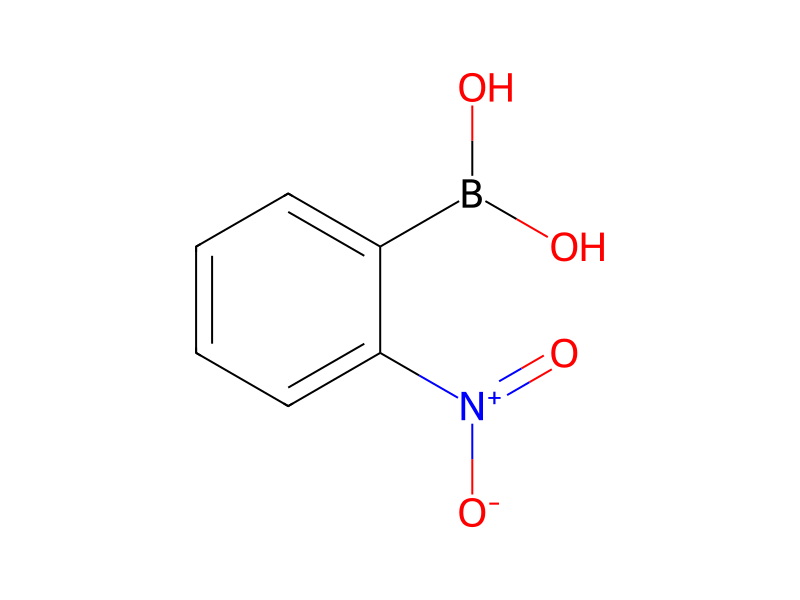
Product 1

Reagents, catalysts & solvents 1

Procedure
Into a 100 mL round bottom flask was added 4-bromophenol (2.07 g, 12.0 mmol), 2-nitrophenylboronic acid (1.00 g, 5.99 mmol), cupric acetate (1.4 g, 7.70 mmol) and DCM (50 mL). TEA (4.0 mL, 29.0 mmol) was then added followed by 4 A° molecular sieves and the reaction mixture was stirred at rt for 48 h. Reaction mixture was then filtered through celite. The filtrate was concentrated in vacuo to give a residue which was purified by silica gel chromatography, eluting with 5% EtOAc in hexane.
Workup
- customReaction mixture
- filtrationwas then filtered through celite
- concentrationThe filtrate was concentrated in vacuo
- customto give a residue which
- customwas purified by silica gel chromatography
- washeluting with 5% EtOAc in hexane
Sources & evidence
- ORD record
- ord-a115ccf9a179472085f2c7d84a9182e6
- Source dataset
- uspto-grants-2013_07
- Patent number
- US08481733B2
Linked notes
Loading…