Reaction equation

C1CC2(CCN1)OCCO2.COc1cncc(Br)c1>CC(=O)O.CC(=O)O.CC(C)(C)[O-].CC(C)c1cc(C(C)C)c(-c2ccccc2P(C2CCCCC2)C2CCCCC2)c(C(C)C)c1.Cc1ccccc1.[Na+].[Pd]>COc1cncc(N2CCC3(CC2)OCCO3)c1Participants
Reactant 2


Product 1

Reagents, catalysts & solvents 4



Conditions
- Temperature
- 100 °C
Procedure
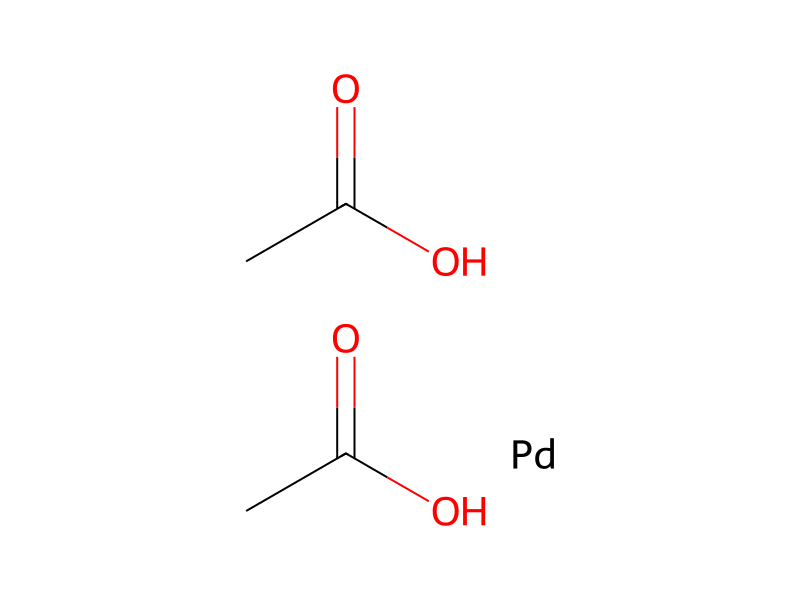
11/05 2011 07:58:54 +0200 A mixture of 3-bromo-5-methoxypyridine (1.5 g, 7.98 mmol), 1,4-dioxa-8-azaspiro[4.5]decane (1.023 ml, 7.98 mmol), palladium(II) acetate (0.107 g, 0.48 mmol) and dicyclohexyl(2',4',6'-triisopropylbiphenyl-2-yl)phosphine (0.228 g, 0.48 mmol) in toluene (38.3 ml) and tBuOH (7.65 ml) was evacuated and flashed with N2 several times. Then sodium 2-methylpropan-2-olate (0.920 g, 9.57 mmol) was added and the reaction mixture was heated to 100°C for 2hrs. LCMS showed complete conversion. Reaction mixture had turned black. The reaction mixture was filtered through celite. The celite was washed with DCM. The combined filtrates were concentrated to yield 2.2g of brown oil, which starts to crystalise patially. Crude NMR showed only little unreacted amine (ca. 14%). The crude was purified by flash: The residue was purified by automated flash chromatography on a 100g column. A gradient from 40% to 100% of EA in Hep over 12CV, 100% EA over 6CV was used as mobile phase. The product was collected using the wavelength 254 nm. 1.5g of desired product were obtained as a light yellow oil.
Sources & evidence
- ORD record
- ord-7ce32a5d4abb4826b07e10a8720e8cf8
- Source dataset
- 750 AstraZeneca ELN dataset
- Original link
- View source
Linked notes
Loading…