HomeMCPSkillsWorkbenchOpenChem
HomeWorkbenchNotificationsMe
llms.txt · skill.md · MCP GuidePrivacy Policy · Terms of Service · Supportv1.8.5
  1. Home
  2. /Reaction

1,3-Propanediamine, N'-(ethylcarbonimidoyl)-N,N-dimethyl-, monohydrochloride → Methyl 5-(4-pyridyl)thiazole-2-carboxylate

HRID 459461
Print

Reaction equation

O.ON1C2C=CC=C[C:6]=2N=N1.Cl.CN(C)CCCN=C=NCC.[N:24]1[CH:29]=[CH:28][C:27]([C:30]2[S:34][C:33]([C:35]([O-:37])=[O:36])=[N:32][CH:31]=2)=[CH:26][CH:25]=1.[Li+]>CO>[N:24]1[CH:29]=[CH:28][C:27]([C:30]2[S:34][C:33]([C:35]([O:37][CH3:6])=[O:36])=[N:32][CH:31]=2)=[CH:26][CH:25]=1
ParticipantsProcedureWorkupSources & evidenceReaction notes

Participants

5

Reactant 3

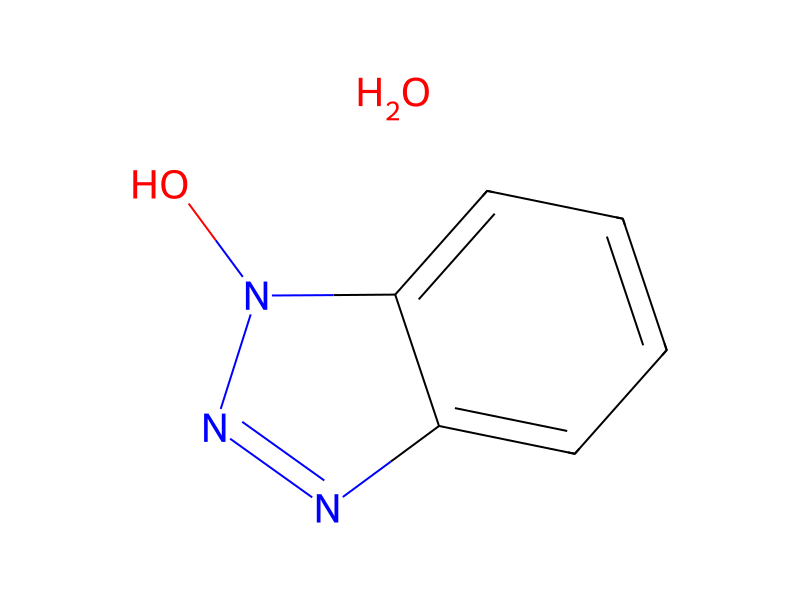
HCID 27239391,3-Propanediamine, N'-(ethylcarbonimidoyl)-N,N-dimethyl-, monohydrochlorideHCID 27960291-Hydroxybenzotriazole hydrateHCID 23674322Lithium 5-(4-pyridyl)thiazole-2-carboxylate

Product 1

HCID 17842642Methyl 5-(4-pyridyl)thiazole-2-carboxylateYield 53.8%

Reagents, catalysts & solvents 1

HCID 887
Methanol
Solvent

Procedure

1-Hydroxybenzotriazole monohydrate (805 mg) and 1-(3-dimethylaminopropyl)-3-ethylcarbodiimide hydrochloride (1.71 g) were added to a solution of lithium 5-(4-pyridyl)thiazole-2-carboxylate (632 mg) in methanol (5.0 ml) at room temperature. After stirring for 4 days, the reaction mixture was concentrated under reduced pressure, and dichloromethane (20 ml), a saturated aqueous solution (100 ml) of sodium hydrogencarbonate and water (100 ml) were added to the residue to separate an organic layer. The water layer was then extracted with dichloromethane (2×20 ml). After the resultant organic layers were combined and dried over anhydrous sodium sulfate, the solvent was distilled off under reduced pressure. The residue was then purified by column chromatography on silica gel (dichloromethane:acetone=5:1→2:1) to obtain the title compound (353 mg) as a colorless solid.

Workup

  1. concentrationthe reaction mixture was concentrated under reduced pressure, and dichloromethane (20 ml)
  2. additiona saturated aqueous solution (100 ml) of sodium hydrogencarbonate and water (100 ml) were added to the residue
  3. customto separate an organic layer
  4. extractionThe water layer was then extracted with dichloromethane (2×20 ml)
  5. dry with materialdried over anhydrous sodium sulfate
  6. distillationthe solvent was distilled off under reduced pressure
  7. customThe residue was then purified by column chromatography on silica gel (dichloromethane:acetone=5:1→2:1)

Sources & evidence

ORD record
ord-6ff7152d71124235a52148445db50ece
Source dataset
uspto-grants-2007_03
DOI
10.6084/m9.figshare.5104873.v1
Patent number
US07192968B2

Reaction notes

On this pageParticipantsProcedureWorkupSources & evidenceReaction notes