HomeMCPWorkbenchSkills
HomeWorkbenchNotificationsMe
llms.txt · MCP GuidePrivacy Policy · Terms of Service · Supportv1.8.0
  1. Home
  2. /Reaction

Potassium Hydroxide → 1-Chloro-4-(3-phenylpropyl)benzene

HRID 463513
Notes
Print preview

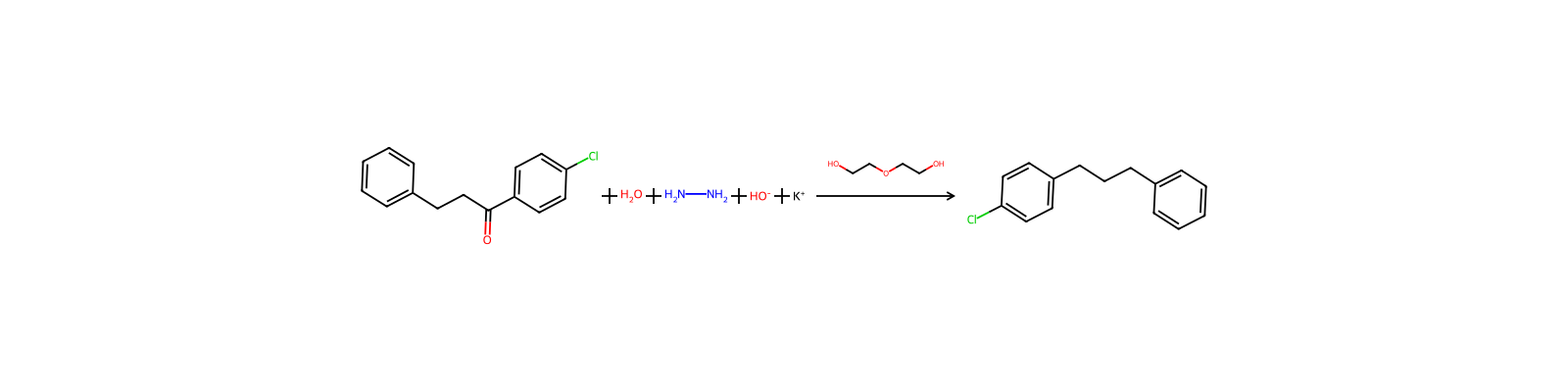
Reaction equation

HRID 463513 reaction equation
[C:1]1([CH2:7][CH2:8][C:9]([C:11]2[CH:16]=[CH:15][C:14]([Cl:17])=[CH:13][CH:12]=2)=O)[CH:6]=[CH:5][CH:4]=[CH:3][CH:2]=1.O.NN.[OH-].[K+]>C(O)COCCO>[Cl:17][C:14]1[CH:13]=[CH:12][C:11]([CH2:9][CH2:8][CH2:7][C:1]2[CH:2]=[CH:3][CH:4]=[CH:5][CH:6]=2)=[CH:16][CH:15]=1
ParticipantsProcedureWorkupSources & evidenceReaction notes

Participants

5

Reactant 3

HCID 14797Potassium HydroxideHCID 24654Hydrazine hydrate (1:1)HCID 2473444'-Chloro-3-phenylpropiophenone

Product 1

HCID 133008571-Chloro-4-(3-phenylpropyl)benzene

Reagents, catalysts & solvents 1

HCID 8117Diethylene GlycolSolvent

Procedure

p-chlorophenyl phenylethyl ketone (25 g) was refluxed with hydrazine hydrate (13 g) and potassium hydroxide (18 g) in Digol (diethylene glycol) for one hour. The mixture was then distilled until the solution temperature in the still reached 175°. The mixture was then refluxed for 3 hours, cooled, poured into water and extracted with petroleum ether (Bpt 40°-60°). Evaporation of the extracts gave 1-(4-chlorophenyl)-3-phenylpropane Bbt. 110°/10-3 mm.

Workup

  1. distillationThe mixture was then distilled until the solution temperature in the still reached 175°
  2. temperatureThe mixture was then refluxed for 3 hours
  3. temperaturecooled
  4. additionpoured into water
  5. extractionextracted with petroleum ether (Bpt 40°-60°)
  6. customEvaporation of the extracts

Sources & evidence

ORD record
ord-3ea19a854acc474080cbdd3124680918
Source dataset
uspto-grants-1985_05
DOI
10.6084/m9.figshare.5104873.v1
Patent number
US04520007

Reaction notes

Loading…

On this pageParticipantsProcedureWorkupSources & evidenceReaction notes