HomeMCPSkillsWorkbenchOpenChem
HomeWorkbenchNotificationsMe
llms.txt · skill.md · MCP GuidePrivacy Policy · Terms of Service · Supportv1.8.5
  1. Home
  2. /Reaction

Phenylboronic Acid → Ethyl 4,6-diphenyl-3-(3-ethoxy-3-oxopropyl)-1H-indole-2-carboxylate

HRID 467428
Print

Reaction equation

Br[C:2]1[CH:10]=[C:9](Br)[CH:8]=[C:7]2[C:3]=1[C:4]([CH2:17][CH2:18][C:19]([O:21][CH2:22][CH3:23])=[O:20])=[C:5]([C:12]([O:14][CH2:15][CH3:16])=[O:13])[NH:6]2.[C:24]1(B(O)O)[CH:29]=[CH:28][CH:27]=[CH:26][CH:25]=1.O.O.O.P([O-])([O-])([O-])=O.[K+].[K+].[K+]>Cl[Pd](Cl)([P](C1C=CC=CC=1)(C1C=CC=CC=1)C1C=CC=CC=1)[P](C1C=CC=CC=1)(C1C=CC=CC=1)C1C=CC=CC=1.O1CCOCC1>[C:24]1([C:2]2[CH:10]=[C:9]([C:2]3[CH:10]=[CH:9][CH:8]=[CH:7][CH:3]=3)[CH:8]=[C:7]3[C:3]=2[C:4]([CH2:17][CH2:18][C:19]([O:21][CH2:22][CH3:23])=[O:20])=[C:5]([C:12]([O:14][CH2:15][CH3:16])=[O:13])[NH:6]3)[CH:29]=[CH:28][CH:27]=[CH:26][CH:25]=1
ParticipantsProcedureWorkupSources & evidenceReaction notes

Participants

6

Reactant 3

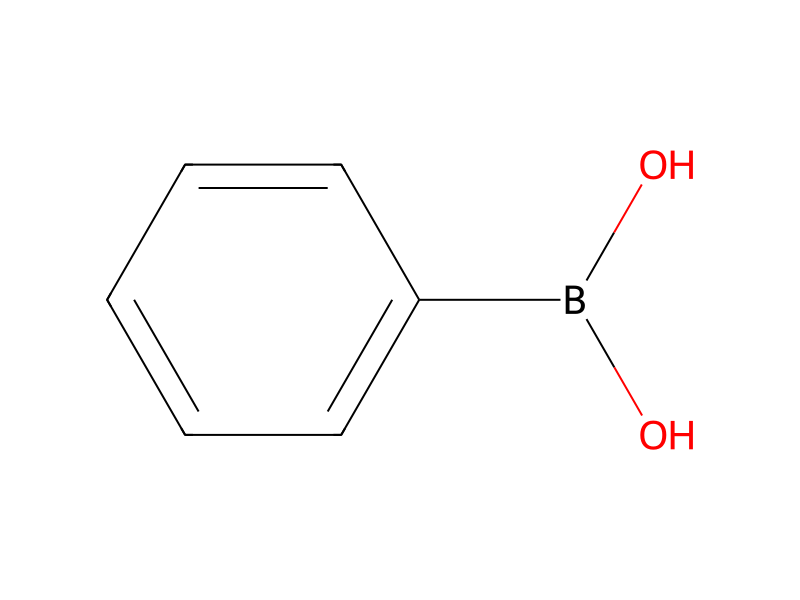
HCID 66827Phenylboronic AcidHCID 18407952Tripotassium phosphate trihydrateHCID 71280731ethyl 4,6-dibromo-3-(3-ethoxy-3-oxopropyl)-1H-indole-2-carboxylate

Product 1

HCID 71281244Ethyl 4,6-diphenyl-3-(3-ethoxy-3-oxopropyl)-1H-indole-2-carboxylate

Reagents, catalysts & solvents 2

HCID 178418476
HCID 178418476, compound
Catalyst
HCID 312751,4-DioxaneSolvent

Procedure

Ethyl 4,6-dibromo-3-(3-ethoxy-3-oxopropyl)-1H-indole-2-carboxylate (0.244 g, 0.5 mmol), phenylboronic acid (0.147 g, 1.2 mmol, 2.4 equiv.) and potassium phosphate trihydrate (0.400 g, 1.5 mmol, 3.0 equiv.) were mixed together in a 10 ml microwave vial. The vial was purged with Argon and trans-dichlorobis(triphenylphosphine)-palladium (II) (0.021, 0.03 mmol, 6 mol %) and 5 ml of dry dioxane were added to the mixture. The microwave vial was capped and irradiated at 100 watt, 150° C., under pressure up to 10 bars. Then it was allowed to cool down to rt, and toluene was removed under reduced pressure and the residue was dissolved in dichloromethane and washed with water. The organic layer was dried over magnesium sulfate, filtered, and evaporated to dryness. The residue was purified by silica gel column chromatography using 20% of ethyl acetate/cyclohexane as eluent to yield a light-beige-colored solid in 60-70%. 1H-NMR (DMSO-d6) δ 1.09, 1.32 (each t, 3H, 3J=7.1 Hz, CH3); 2.11 (m, 2H, 2′-H); 2.84 (m, 2H, 1′-H); 3.89, 4.33 (each q, 2H, 4J=7.1 Hz, CH2); 7.12 (d, 1H, 2J=1.6 Hz, 7-H); 7.35 (t, 1H, 3J=7.4 Hz, Ph-ring); 7.43 (m, 7H, Ph-ring); 7.67 (d, 1H, 2J=0.9 Hz, 5-H); 7.68 (d, 1H, 2J=1.6 Hz, Phenyl-ring); 11.84 (s, 1H, NH). 13C-NMR (DMSO-d6) δ 14.2, 14.3 (2CH3, each C═OOCH2CH3); 20.5 (C-2′); 34.8 (C-1′); 59.5, 60.5 (2CH2, each C═OOCH2CH3); 109.6 (C-5); 121.1 (C-7); 121.8 (C-3); 123.6 (C-2); 124.7 (C-3a); 127.0 (C-2″, C-6″); 127.4 (C-4″′); 127.5 (C-4″); 128.0 (C-3″′, C-5″′); 129.0 (C-3″, C-5″); 129.1 (C-2″′, C-6″′); 136.7 (C-7a); 137.4 (C-4), 137.6 (C-6); 140.7 (C-1″); 140.8 (C-1″′); 161.5 (2′-CO2Et); 171.7 (2-CO2Et). LC-MS (m/z): 442 [M]+, 440 [M]−. Purity (LC-MS): 96%.

Workup

  1. additionwere added to the mixture
  2. customThe microwave vial was capped
  3. customirradiated at 100 watt, 150° C., under pressure up to 10 bars
  4. customtoluene was removed under reduced pressure
  5. dissolutionthe residue was dissolved in dichloromethane
  6. washwashed with water
  7. dry with materialThe organic layer was dried over magnesium sulfate
  8. filtrationfiltered
  9. customevaporated to dryness
  10. customThe residue was purified by silica gel column chromatography
  11. customto yield a light-beige-colored solid in 60-70%

Sources & evidence

ORD record
ord-15a807af808840cab4693c1f419c103e
Source dataset
uspto-grants-2014_01
DOI
10.6084/m9.figshare.5104873.v1
Patent number
US08623593B1

Reaction notes

On this pageParticipantsProcedureWorkupSources & evidenceReaction notes

