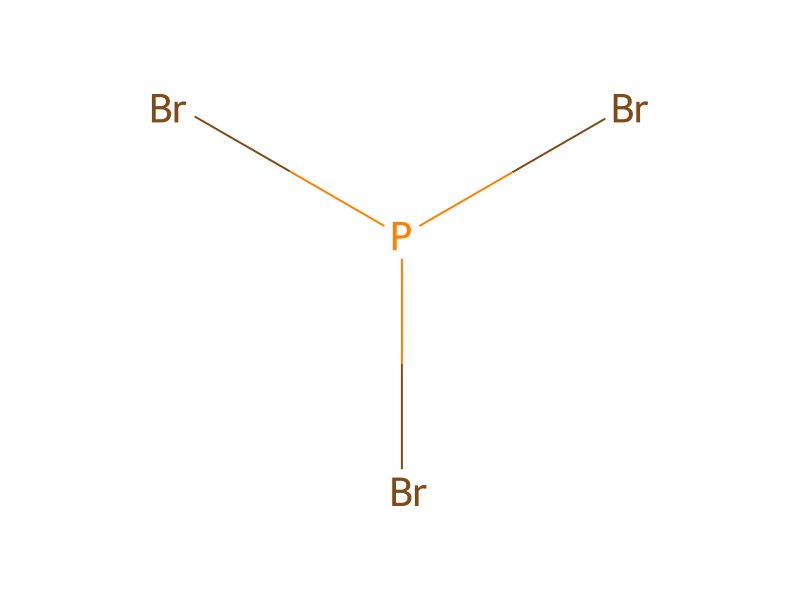
Phosphorus tribromide → 5-(1-Bromoethyl)-6-methyl-4-(3-nitrophenyl)-2-phenylpyrimidine
Reaction equation

O[CH:2]([C:4]1[C:5]([C:17]2[CH:22]=[CH:21][CH:20]=[C:19]([N+:23]([O-:25])=[O:24])[CH:18]=2)=[N:6][C:7]([C:11]2[CH:16]=[CH:15][CH:14]=[CH:13][CH:12]=2)=[N:8][C:9]=1[CH3:10])[CH3:3].P(Br)(Br)[Br:27]>O1CCCC1>[Br:27][CH:2]([C:4]1[C:5]([C:17]2[CH:22]=[CH:21][CH:20]=[C:19]([N+:23]([O-:25])=[O:24])[CH:18]=2)=[N:6][C:7]([C:11]2[CH:16]=[CH:15][CH:14]=[CH:13][CH:12]=2)=[N:8][C:9]=1[CH3:10])[CH3:3]Participants
4



Procedure
A solution of 5-(1-hydroxyethyl)-6-methyl-4-(3-nitrophenyl)-2-phenylpyrimidine (1.8 g) in tetrahydrofuran (10 ml) was dropped to a solution of phosphorus tribromide (0.34 ml) in tetrahydrofuran (20 ml) under ice cooling. The reaction mixture was stirred for 5 hours at the same condition and poured into ice water and extracted with ethyl acetate. The organic layer was evaporated in vacuo. The residue was chromatographed on silicagel eluting with chloroform. The fractions containing the desired product were combined and evaporated in vacuo. The residue was crystallized from diisopropyl ether to afford 5-(1-bromoethyl)-6-methyl-4-(3-nitrophenyl)-2-phenylpyrimidine (0.3 g).