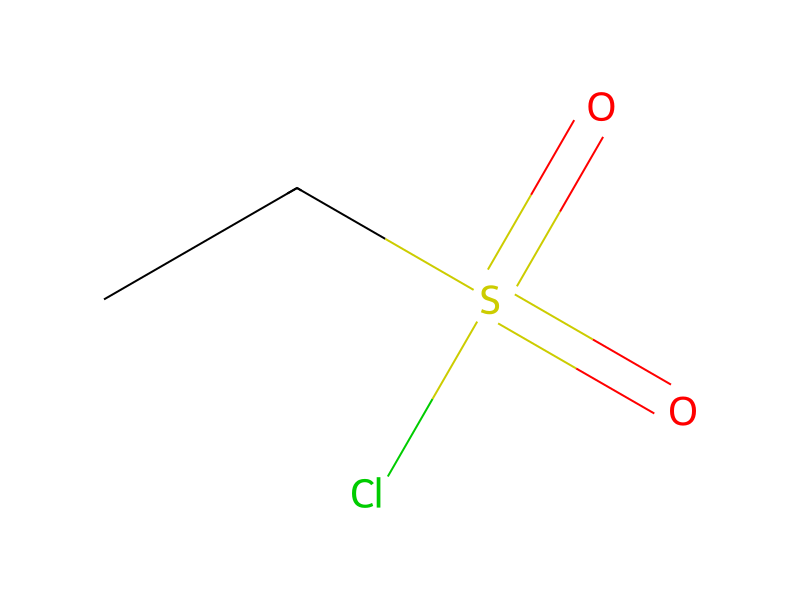
[NH2:1][C:2]1[CH:3]=[CH:4][C:5]([CH3:24])=[C:6]([C:8]2[CH:17]=[C:16]3[C:11]([CH:12]=[C:13]([NH:18][C:19]([CH:21]4[CH2:23][CH2:22]4)=[O:20])[N:14]=[CH:15]3)=[CH:10][CH:9]=2)[CH:7]=1.N1C=CC=CC=1.[CH2:31]([S:33](Cl)(=[O:35])=[O:34])[CH3:32]>ClCCl>[CH2:31]([S:33]([NH:1][C:2]1[CH:3]=[CH:4][C:5]([CH3:24])=[C:6]([C:8]2[CH:17]=[C:16]3[C:11]([CH:12]=[C:13]([NH:18][C:19]([CH:21]4[CH2:22][CH2:23]4)=[O:20])[N:14]=[CH:15]3)=[CH:10][CH:9]=2)[CH:7]=1)(=[O:35])=[O:34])[CH3:32]To a solution of N-(7-(5-amino-2-methylphenyl)isoquinolin-3-yl)cyclopropanecarboxamide (56.2 mg, 0.177 mmol) in methylene chloride (2.0 mL, 31 mmol) was added pyridine (0.20 mL, 2.5 mmol) and ethanesulfonyl chloride (23.0 uL, 0.243 mmol). The reaction mixture was stirred at room temperature for 2 hours. The reaction mixture was then poured into dichloromethane, washed with water, dried over MgSO4, filtered, and evaporated in vacuo. The crude product was purified via reverse phase HPLC and lyophilized to yield 39.5 mg (54%) of N-(7-(5-(ethylsulfonamido)-2-methylphenyl)isoquinolin-3-yl)cyclopropanecarboxamide. LCMS (ESI): RT (min)=4.534, M+H=410.1, method=E; 1H NMR (400 MHz, DMSO-d6) δ 10.90 (s, 1H), 9.73 (s, 1H), 9.18 (s, 1H), 8.49 (s, 1H), 7.98 (s, 1H), 7.92 (d, J=8.6 Hz, 1H), 7.66 (dd, J=8.5, 1.6 Hz, 1H), 7.29 (d, J=8.2 Hz, 1H), 7.18 (dd, J=8.1, 2.3 Hz, 1H), 7.15 (d, J=2.2 Hz, 1H), 3.10 (q, J=7.3 Hz, 2H), 2.21 (s, 3H), 2.12-2.04 (m, 1H), 1.21 (t, J=7.3 Hz, 3H), 0.84 (m, 4H).