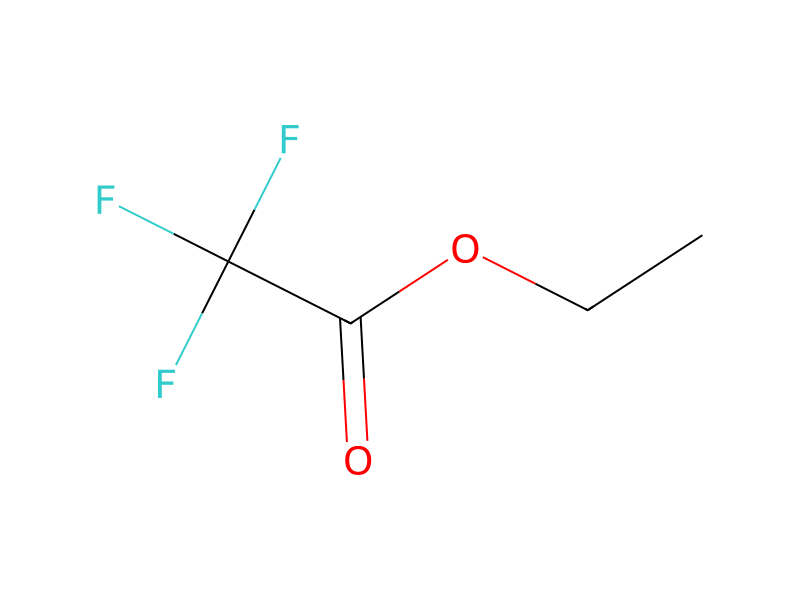
Into a 50 ml autoclave were poured 10.6 g (100 mmol) of potassium salt of imidazole and tetrahydrofuran (30 ml), and the inside of the autoclave was cooled to −78° C., and evacuation and replacement by nitrogen were carried out three times. After the inside of a system was evacuated, TFE was introduced until the inside pressure of the system reached 0.1 MPa·G. Then the temperature of the reaction system was increased to 100° C., and TFE was further introduced to maintain the inside pressure of the reaction system at 0.3 to 0.5 MPa·G. Supply of TFE was stopped when the amount of TFE reached 1.1 equivalents (11 g=110 mmol) to the potassium salt of imidazole, and stirring was continued at 100° C. Fifteen hours after starting of the stirring, the inside of the reaction system was brought to room temperature, followed by evacuation to terminate the reaction. To this crude reaction product was added 2.84 g (20 mmol) of ethyl trifluoroacetate, and it was confirmed by a 19F-NMR analysis based on ethyl trifluoroacetate that 1-(1,1,2,2-tetrafluoroethyl)imidazole had been produced at yield of 13% and 1-(1,2,2-trifluoroethenyl)imidazole had been produced at yield of 56%. Also according to gas chromatography analysis, it was confirmed that 14% of imidazole remained.