HomeMCPSkillsWorkbenchOpenChem
HomeWorkbenchNotificationsMe
llms.txt · skill.md · MCP GuidePrivacy Policy · Terms of Service · Supportv1.8.5
  1. Home
  2. /Reaction

Triethylamine → 1-bromo-N-(2-oxopentyl)-cyclopropane-1-carbamide

HRID 478139
Print

Reaction equation

[Br:1][C:2]1([C:5]([OH:7])=O)[CH2:4][CH2:3]1.Cl.[NH2:9][CH2:10][C:11](=[O:15])[CH2:12][CH2:13][CH3:14].C1(N=C=NC2CCCCC2)CCCCC1.C(N(CC)CC)C>C(Cl)Cl>[Br:1][C:2]1([C:5]([NH:9][CH2:10][C:11](=[O:15])[CH2:12][CH2:13][CH3:14])=[O:7])[CH2:4][CH2:3]1
ParticipantsProcedureWorkupSources & evidenceReaction notes

Participants

6

Reactant 4

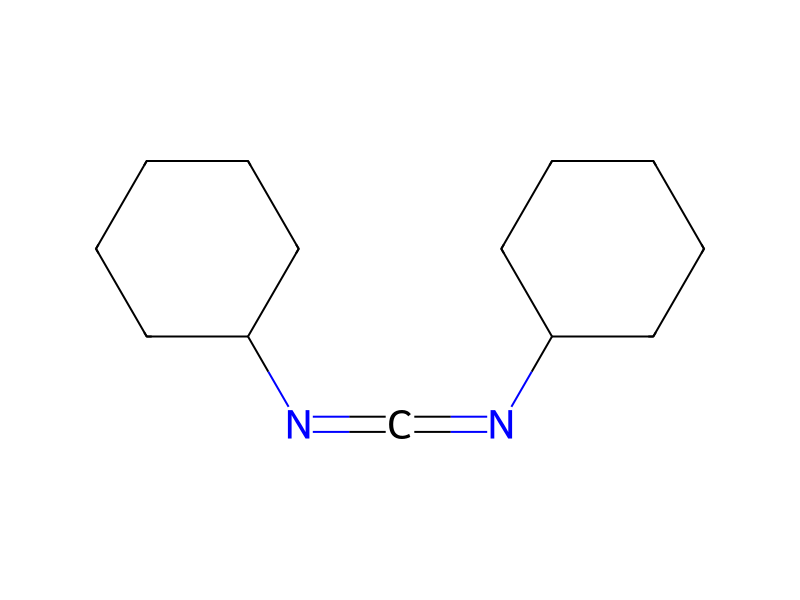
HCID 8471TriethylamineHCID 10868DicyclohexylcarbodiimideHCID 125517611-Aminopentan-2-one hydrochlorideHCID 128674801-Bromocyclopropane-1-carboxylic acid

Product 1

HCID 180009151-bromo-N-(2-oxopentyl)-cyclopropane-1-carbamideYield 70.9%

Reagents, catalysts & solvents 1

HCID 6344
Dichloromethane
Solvent

Procedure

A mixture of 2.57 g of 1-bromocyclopropanecarboxylic acid 4 [H. M. R. Hoffmann et al. J. Org. Chem. 54, 6096 (1989)], 2.22 g of 1-amino-2-pentanone hydrochloride 5 [M. Jackman et al. J. Am. Chem. Soc. 70, 2884 (1948)] and 3.36 g of N,N′-dicyclohexylcarbodiimide in 234 ml of methylene chloride in the presence of 2.46 ml of triethylamine is stirred overnight at room temperature. Then, it is filtered, the filtrate is concentrated by evaporation, and the residue is chromatographed on silica gel with ethyl acetate/hexane. 2.74 g of 1-bromo-N-(2-oxopentyl)-cyclopropane-1-carbamide 6 is obtained as a crystallizing oil.

Workup

  1. filtrationThen, it is filtered
  2. concentrationthe filtrate is concentrated by evaporation
  3. customthe residue is chromatographed on silica gel with ethyl acetate/hexane

Sources & evidence

ORD record
ord-20ed1aef6b504929a9e53964d84a2785
Source dataset
uspto-grants-2003_11
DOI
10.6084/m9.figshare.5104873.v1
Patent number
US06642218B2

Reaction notes

On this pageParticipantsProcedureWorkupSources & evidenceReaction notes