Benzoic acid 1-cyano-3-(4-methoxyphenyl)-allyl ester → 4-(4-Methoxyphenyl)but-3-enenitrile
HRID 48131
Reaction equation
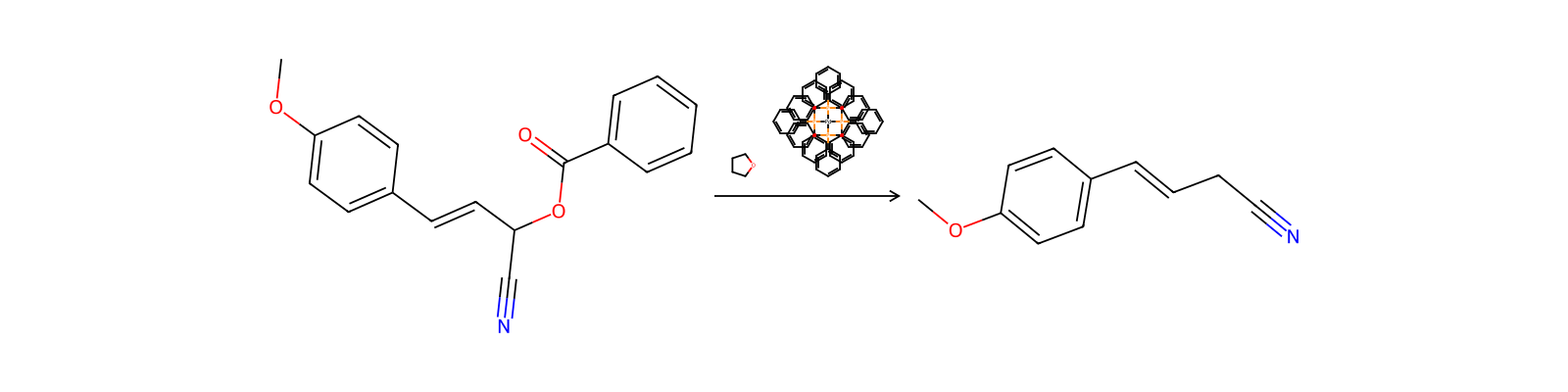
[C:1]([CH:3](OC(=O)C1C=CC=CC=1)[CH:4]=[CH:5][C:6]1[CH:11]=[CH:10][C:9]([O:12][CH3:13])=[CH:8][CH:7]=1)#[N:2]>O1CCCC1.C1C=CC([P]([Pd]([P](C2C=CC=CC=2)(C2C=CC=CC=2)C2C=CC=CC=2)([P](C2C=CC=CC=2)(C2C=CC=CC=2)C2C=CC=CC=2)[P](C2C=CC=CC=2)(C2C=CC=CC=2)C2C=CC=CC=2)(C2C=CC=CC=2)C2C=CC=CC=2)=CC=1>[CH3:13][O:12][C:9]1[CH:10]=[CH:11][C:6]([CH:5]=[CH:4][CH2:3][C:1]#[N:2])=[CH:7][CH:8]=1Participants
4
Reactant 1

Product 1

Reagents, catalysts & solvents 2


Procedure
Benzoic acid 1-cyano-3-(4-methoxy-phenyl)-allyl ester (15 g; ca 0.050 mol) is dissolved in 100 ml of anhydrous tetrahydrofuran. Tetrakis(triphenylphosphine)palladium (0.88 g; 0.8 mmol) and 4.8 ml of poly(methylhydrosiloxane) (ca 80 meq; Aldrich) are added, and the mixture is stirred at ca 20° C., cooling with a cold water bath. After 3 h 30 min, the mixture is concentrated by rotary evaporation, stirred with 150 ml of water to hydrolyze the siloxane. The polymer and organic materials are redissolved in CH2Cl2 and washed with saturated sodium bicarbonate to remove benzoic acid. Evaporation of the solvent and flash chromatography (150 g SiO2; hexane:ethyl acetate 80:20 v:v) affords 4.9 g (57%) of pure 4-(4-methoxy-phenyl)-but-3-enenitrile, mp 75-76° C.