Reaction equation

N[C:2]1[S:3][C:4]([N+:7]([O-:9])=[O:8])=[CH:5][N:6]=1.N([O-])=O.[Na+].[BrH:14].[C:15](Cl)(=[O:22])[C:16]1[CH:21]=[CH:20][CH:19]=[CH:18][CH:17]=1.[NH2:24][NH:25][C:26]([NH2:28])=[S:27]>N1C=CC=CC=1>[Br:14][C:2]1[S:3][C:4]([N+:7]([O-:9])=[O:8])=[CH:5][N:6]=1.[C:16]1([C:15]2[N:24]=[N:25][C:26](=[S:27])[N:28]=2)[CH:21]=[CH:20][CH:19]=[CH:18][CH:17]=1.[C:15]([NH:24][NH:25][C:26]([NH2:28])=[S:27])(=[O:22])[C:16]1[CH:21]=[CH:20][CH:19]=[CH:18][CH:17]=1Participants
Reactant 5



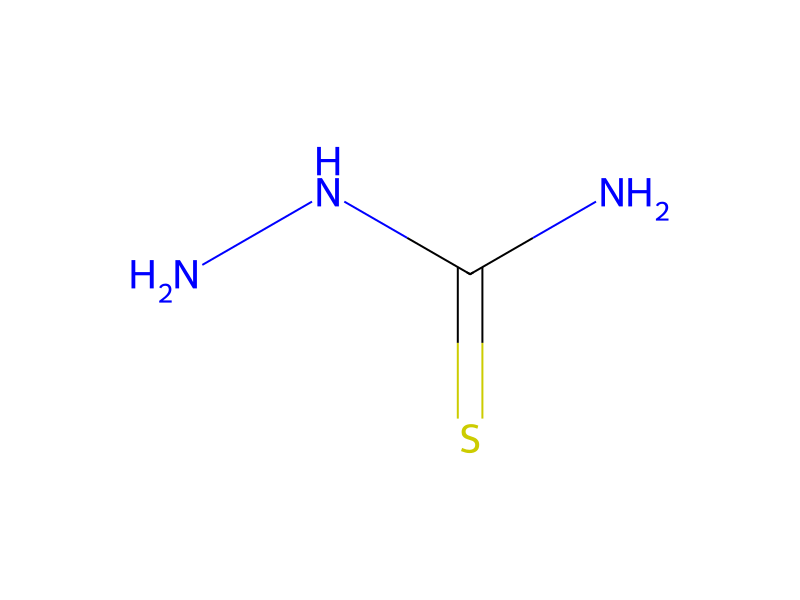

Product 3


Reagents, catalysts & solvents 1

Procedure
The starting material 2-bromo-5-nitrothiazole was prepared by treating 2-amino-5-nitrothiazole (Aldrich) with sodium nitrite and hydrogen bromide (Fr. Demande 2,015,434, 1970). 3-Phenyl-1,2,4-triazole-5-thione (E. Hogarth, J. Chem. Soc. (1949) 1163) was prepared by first reacting benzoyl chloride with thiosemicarbazide in pyridine at 0° C. to give benzoyl thiosemicarbazide. Benzoyl thiosemicarbazide was treated with potassium hydroxide in ethanol to give 3-phenyl-1,2,4-triazole-5-thione. 3-Phenyl-1,2,4-triazole-5-thione (1.77 g) was then dissolved in 50 mL of methanol and treated with 0.57 g of 95% sodium methoxide, and then with 2-bromo-5-nitrothiazole (2.09 g). The mixture was stirred at room temperature for 2 hours and the precipitated sodium bromide was removed by filtration. The methanol was evaporated and the product crystallized from ethanol and water to give 1.5 g of 3-[(5-nitrothiazol-2-yl)mercapto]-5-phenyl-1,2,4-triazole, a white solid, MP 155°-157° C.
Workup
- customat 0° C.
Sources & evidence
- ORD record
- ord-1e326b8766314f45a018e4614da53398
- Source dataset
- uspto-grants-1998_08
- Patent number
- US05798374
Linked notes
Loading…