Reaction equation
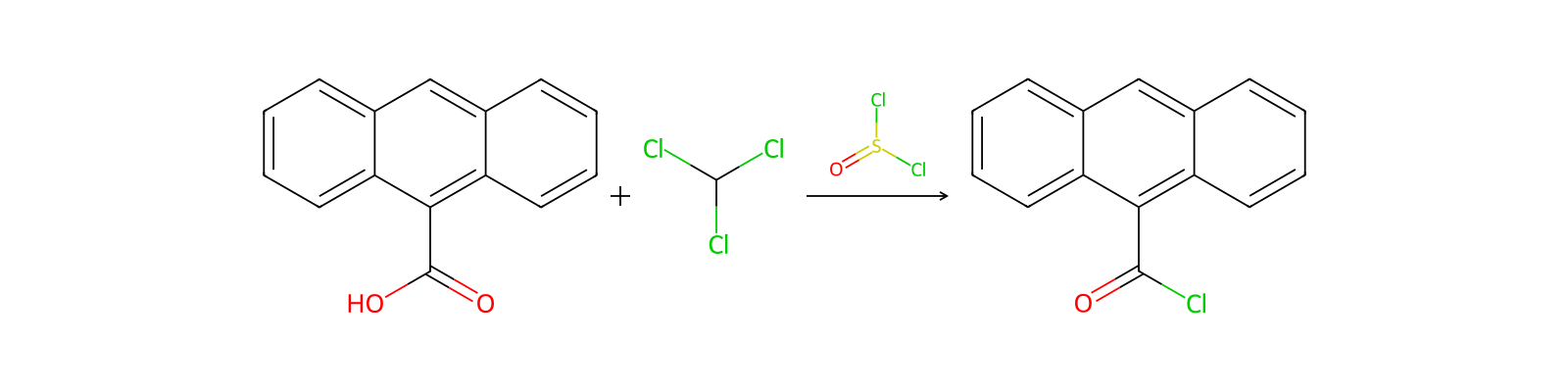
[CH:1]1[C:14]2[C:5](=[CH:6][C:7]3[C:12]([C:13]=2[C:15]([OH:17])=O)=[CH:11][CH:10]=[CH:9][CH:8]=3)[CH:4]=[CH:3][CH:2]=1.C(Cl)(Cl)[Cl:19]>S(Cl)(Cl)=O>[CH:1]1[C:14]2[C:5](=[CH:6][C:7]3[C:12]([C:13]=2[C:15]([Cl:19])=[O:17])=[CH:11][CH:10]=[CH:9][CH:8]=3)[CH:4]=[CH:3][CH:2]=1Participants
Reactant 2
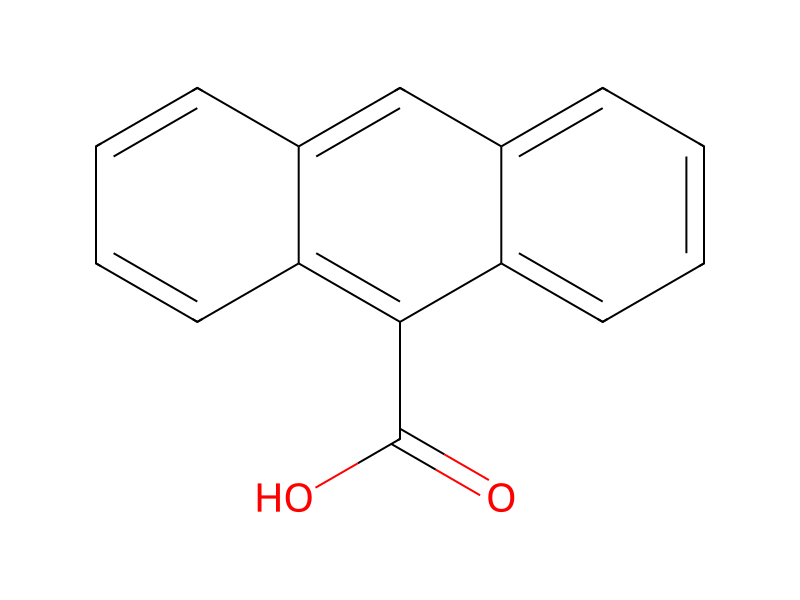

Product 1
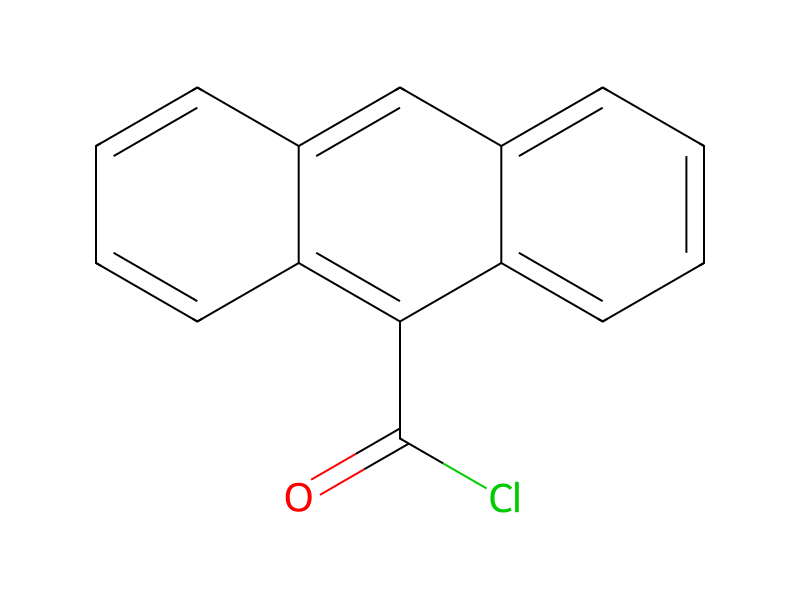
Reagents, catalysts & solvents 1

Procedure
Anthracene-9-carboxylic acid (recrystallized from ethanol, 12.05 g, 54.3 mmol) was suspended in a mixture of chloroform (60 mL, Aldrich, amylenes-stabilized) and thionyl chloride (12 mL) and heated under reflux until a clear solution was obtained (about 30 minutes). The solvent was removed by distillation under reduced pressure and the residual hot oil was dissolved in toluene (20 mL) and hexane (100 mL) was added. After cooling to ambient temperature the crystalline product was collected by filtration and dried in a stream of nitrogen then under high vacuum to give the title compound as a yellow solid (7.69 g, 59%). Non-commercially available carboxylic acids referred to in this section were prepared as described below. If desired they were converted to the corresponding carbonyl chloride using thionyl chloride as described above.
Workup
- temperatureheated
- temperatureunder reflux until a clear solution
- customwas obtained (about 30 minutes)
- customThe solvent was removed by distillation under reduced pressure
- dissolutionthe residual hot oil was dissolved in toluene (20 mL)
- additionhexane (100 mL) was added
- filtrationwas collected by filtration
- customdried in a stream of nitrogen
Sources & evidence
- ORD record
- ord-6d6df2e26fae423f9920d14f54d9331b
- Source dataset
- uspto-grants-2005_12
- Patent number
- US06979741B2
Linked notes
Loading…