HomeMCPWorkbenchSkills
HomeWorkbenchNotificationsMe
llms.txt · MCP GuidePrivacy Policy · Terms of Service · Supportv1.8.3
  1. Home
  2. /Reaction

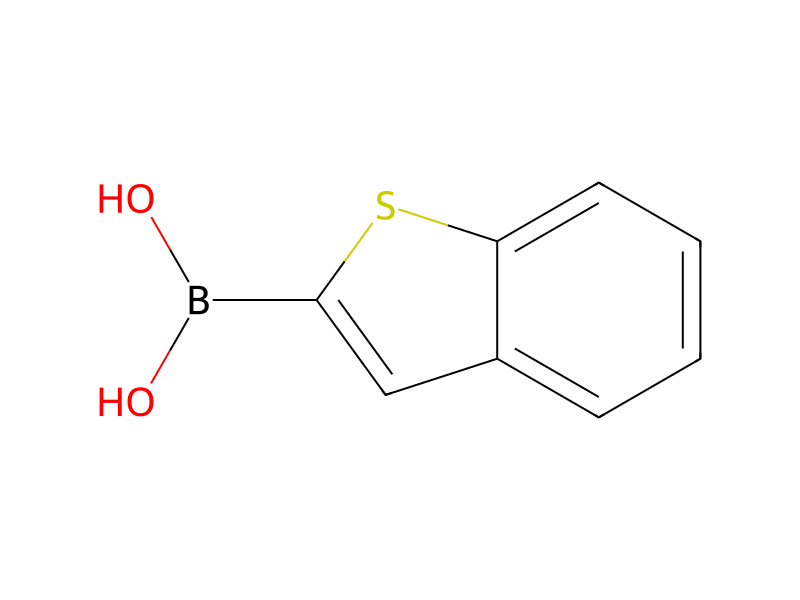
Benzo(B)Thiophene-2-Boronic Acid → 2-(1-Benzothien-2-yl)-5-nitrobenzamide

HRID 503690
Print

Reaction equation

HRID 503690 reaction equation
I[C:2]1[CH:10]=[CH:9][C:8]([N+:11]([O-:13])=[O:12])=[CH:7][C:3]=1[C:4]([NH2:6])=[O:5].C(=O)([O-])[O-].[Na+].[Na+].[S:20]1[C:24]2[CH:25]=[CH:26][CH:27]=[CH:28][C:23]=2[CH:22]=[C:21]1B(O)O>Cl[Pd](Cl)([P](C1C=CC=CC=1)(C1C=CC=CC=1)C1C=CC=CC=1)[P](C1C=CC=CC=1)(C1C=CC=CC=1)C1C=CC=CC=1.O1CCOCC1>[S:20]1[C:24]2[CH:25]=[CH:26][CH:27]=[CH:28][C:23]=2[CH:22]=[C:21]1[C:2]1[CH:10]=[CH:9][C:8]([N+:11]([O-:13])=[O:12])=[CH:7][C:3]=1[C:4]([NH2:6])=[O:5]
ParticipantsConditionsProcedureWorkupSources & evidenceReaction notes

Participants

6

Reactant 3

HCID 2359Benzo(B)Thiophene-2-Boronic AcidHCID 10340Sodium CarbonateHCID 98039472-Iodo-5-nitrobenzamide

Product 1

HCID 594284732-(1-Benzothien-2-yl)-5-nitrobenzamideYield 70.9%

Reagents, catalysts & solvents 2

HCID 178418476HCID 178418476, compoundCatalyst
HCID 312751,4-DioxaneSolvent

Conditions

Temperature
80 °C

Procedure

2-Iodo-5-nitrobenzamide (Example 3A; 6.56 g) is introduced into dioxane (130 ml) and sat. sodium carbonate solution (65 ml) and, after addition of benzothiophene-2-boronic acid (6.00 g) and dichlorobis(triphenylphosphine)palladium (1.58 g), stirred at 80° C. overnight. The reaction mixture is filtered through kieselguhr and washed with ethyl acetate (250 ml) and water (100 ml). The organic phase is extracted with water (three times 100 ml) and sat. sodium chloride solution (100 ml) and then dried over sodium sulfate and concentrated in a rotary evaporator. The residue is chromatographed on silica gel (cyclohexane:ethyl acetate 10:1--->pure ethyl acetate). After the product fractions have been concentrated in a rotary evaporator, the target compound is suspended in diethyl ether, filtered off with suction and dried. 4.75 g of product (64% of theory) are obtained.

Workup

  1. filtrationThe reaction mixture is filtered through kieselguhr
  2. washwashed with ethyl acetate (250 ml) and water (100 ml)
  3. extractionThe organic phase is extracted with water (three times 100 ml) and sat. sodium chloride solution (100 ml)
  4. dry with materialdried over sodium sulfate
  5. concentrationconcentrated in a rotary evaporator
  6. customThe residue is chromatographed on silica gel (cyclohexane:ethyl acetate 10:1--->pure ethyl acetate)
  7. concentrationAfter the product fractions have been concentrated in a rotary evaporator
  8. filtrationfiltered off with suction
  9. customdried

Sources & evidence

ORD record
ord-5d57f406f6224574a40c49613a79de91
Source dataset
uspto-grants-2010_08
DOI
10.6084/m9.figshare.5104873.v1
Patent number
US07776922B2

Reaction notes

On this pageParticipantsConditionsProcedureWorkupSources & evidenceReaction notes