M-Xylene → 2,4-Dichloro-6-(2,4-dimethylphenyl)-1,3,5-triazine
Reaction equation

[N:1]1[C:8](Cl)=[N:7][C:5]([Cl:6])=[N:4][C:2]=1[Cl:3].[C:10]1([CH3:17])[CH:15]=[CH:14][CH:13]=[C:12]([CH3:16])[CH:11]=1.[Al+3].[Cl-].[Cl-].[Cl-]>ClC1C=CC=CC=1>[Cl:3][C:2]1[N:4]=[C:5]([Cl:6])[N:7]=[C:8]([C:15]2[CH:14]=[CH:13][C:12]([CH3:16])=[CH:11][C:10]=2[CH3:17])[N:1]=1Participants
5
Reactant 3

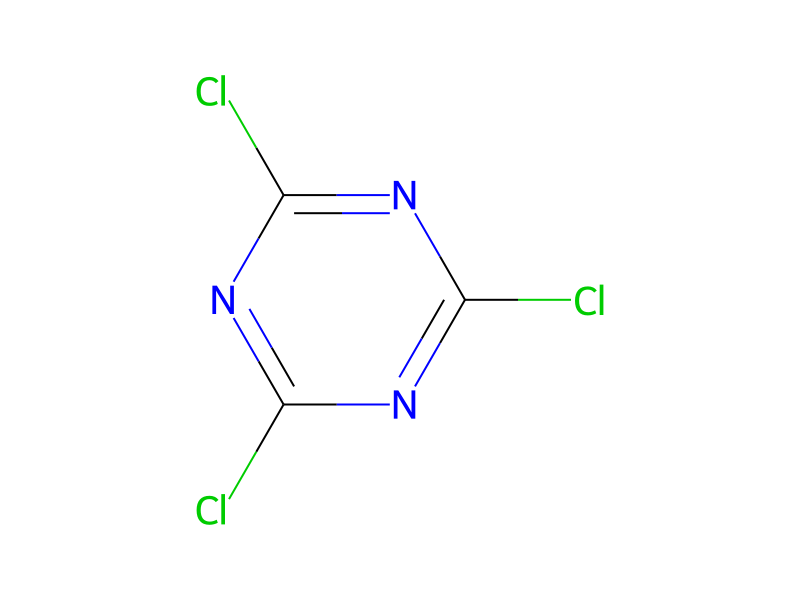

Product 1

Reagents, catalysts & solvents 1

Procedure
Cyanuric chloride (1.84 g) was allowed to react with 1.9 eq of m-xylene and 2.5 eq (3.35 g) of AlCl3 in 25 mL of chlorobenzene at 5° C. for 0.5 h and then at room temperature for 3 h. Analysis by HPLC, after 2.5 h, showed that less than 8% of cyanuric chloride had reacted to form only 2,4-dichloro-6-(2,4-dimethylphenyl)-1,3,5-triazine, no 2-chloro-4,6-bis(2,4-dimethylphenyl)-1,3,5-triazine or 2,4,6-tris(2,4-dimethylphenyl)-1,3,5-triazine were present. The reaction was allowed to continue at room temperature. After 24 hours, HPLC analysis showed about 51% cyanuric chloride conversion and formation of 2,4-dichloro-6-(2,4-dimethylphenyl)-1,3,5-triazine and 2-chloro-4,6-bis(2,4-dimethylphenyl)-1,3,5-triazine in the ratio of 95:5, respectively. No 2,4,6-tris(2,4-dimethylphenyl)-1,3,5-triazine was detected.