Reaction equation
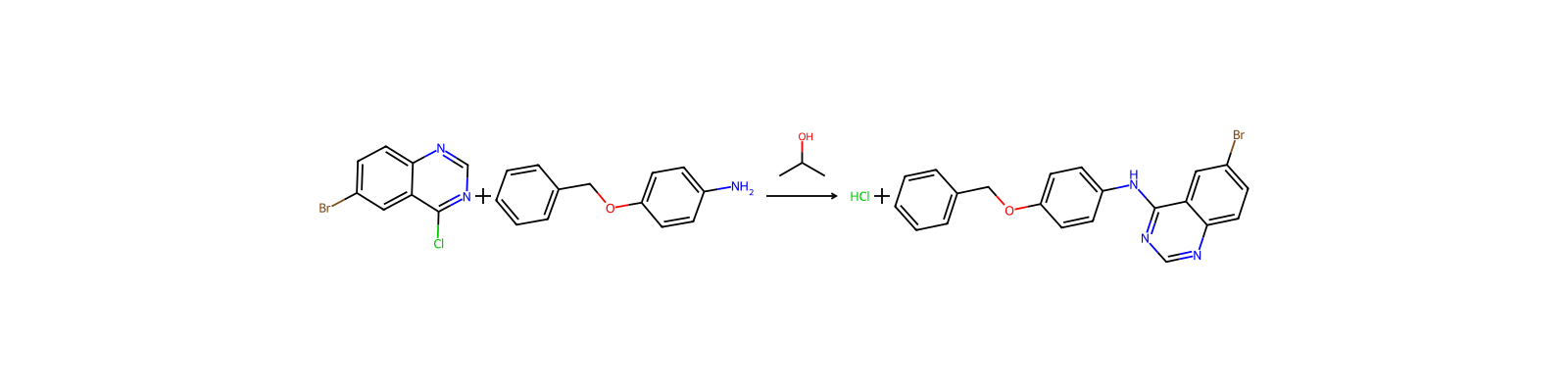
[Cl:1][C:2]1[C:11]2[C:6](=[CH:7][CH:8]=[C:9]([Br:12])[CH:10]=2)[N:5]=[CH:4][N:3]=1.[CH2:13]([O:20][C:21]1[CH:27]=[CH:26][C:24]([NH2:25])=[CH:23][CH:22]=1)[C:14]1[CH:19]=[CH:18][CH:17]=[CH:16][CH:15]=1>CC(O)C>[ClH:1].[CH2:13]([O:20][C:21]1[CH:22]=[CH:23][C:24]([NH:25][C:2]2[C:11]3[C:6](=[CH:7][CH:8]=[C:9]([Br:12])[CH:10]=3)[N:5]=[CH:4][N:3]=2)=[CH:26][CH:27]=1)[C:14]1[CH:15]=[CH:16][CH:17]=[CH:18][CH:19]=1Participants
4
Reactant 2


Product 1

Reagents, catalysts & solvents 1

Procedure
4-Chloro-6-bromoquinazoline (0.25 g, 1.0 mmol) and 4-benzyloxyaniline (0.25 g, 1.3 mmol) were mixed in 2-propanol (6 ml) and heated at reflux for 10 mins (Procedure A). The solution was allowed to cool at room temperature and the 2-propanol removed in vacuo. The resulting solid was triturated with acetone to give the product as a yellow solid (0.39 g, 88%); δH [2H6]-DMSO 11.60 (1H, b, NH), 9.21 (1H, s, 5-H), 8.86 (1H, s, 2-H), 8.20 (1H, d, 7-H), 7.90 (1H, d, 8-H), 7.65 (2H, d, 2′-H, 6′-H), 7.50-7.25 (5H, m, Ph-H), 7.10 (2H, d, 3′-H, 5′-H), 5.15 (2H, s, CH2); m/z 405/407 (M+).
Workup
- temperatureheated
- temperatureat reflux for 10 mins (Procedure A)
- customthe 2-propanol removed in vacuo
- customThe resulting solid was triturated with acetone
Sources & evidence
- ORD record
- ord-428d0d385d4a47b69bc680b52a7dce02
- Source dataset
- uspto-grants-2004_03
- Patent number
- US06713485B2
Linked notes
Loading…