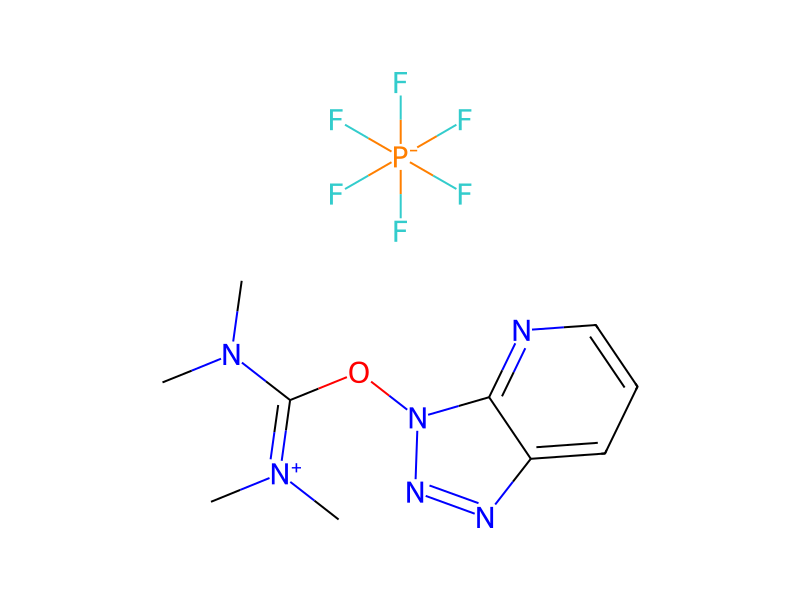
[Br:1][C:2]1[CH:10]=[C:9]([CH2:11][CH3:12])[C:5]([C:6]([OH:8])=O)=[C:4]([CH2:13][CH3:14])[CH:3]=1.C(N(C(C)C)CC)(C)C.F[P-](F)(F)(F)(F)F.N1(OC(N(C)C)=[N+](C)C)C2N=CC=CC=2N=N1.[Cl:48][C:49]1[CH:56]=[CH:55][C:52]([CH2:53][NH2:54])=[CH:51][CH:50]=1>ClCCl>[Br:1][C:2]1[CH:3]=[C:4]([CH2:13][CH3:14])[C:5]([C:6]([NH:54][CH2:53][C:52]2[CH:55]=[CH:56][C:49]([Cl:48])=[CH:50][CH:51]=2)=[O:8])=[C:9]([CH2:11][CH3:12])[CH:10]=1To a solution of 4-bromo-2,6-diethyl-benzoic acid (0.30 g, 1.20 mmol) in dichloromethane (3.6 ml) are added diisopropylethylamine (0.58 ml, 3.56 mmol) and O-(7-azabenzotriazol-1-yl)-N,N,N′,N′-tetramethyluronium hexafluorophosphate (0.54 g, 1.42 mmol) at 0° C. and the mixture is stirred for 20 min followed by the addition of 4-chloro-benzyl amine (0.17 ml, 1.42 mmol). The resulting mixture is stirred at room temperature for 16 h. After completion of the reaction (monitored by TLC) the reaction mixture is diluted with dichloromethane (20 ml) and washed with water (30 ml). The organic layer is dried over sodium sulfate and concentrated in vacuo. The resulting crude product is purified column chromatography (silica gel, 25% ethyl acetate/hexane) to obtain 4-bromo-N-[(4-chlorophenyl)-methyl]-2,6-diethyl-benzamide (0.34 g, 0.90 mmol, 75%).
Loading…