Reaction equation
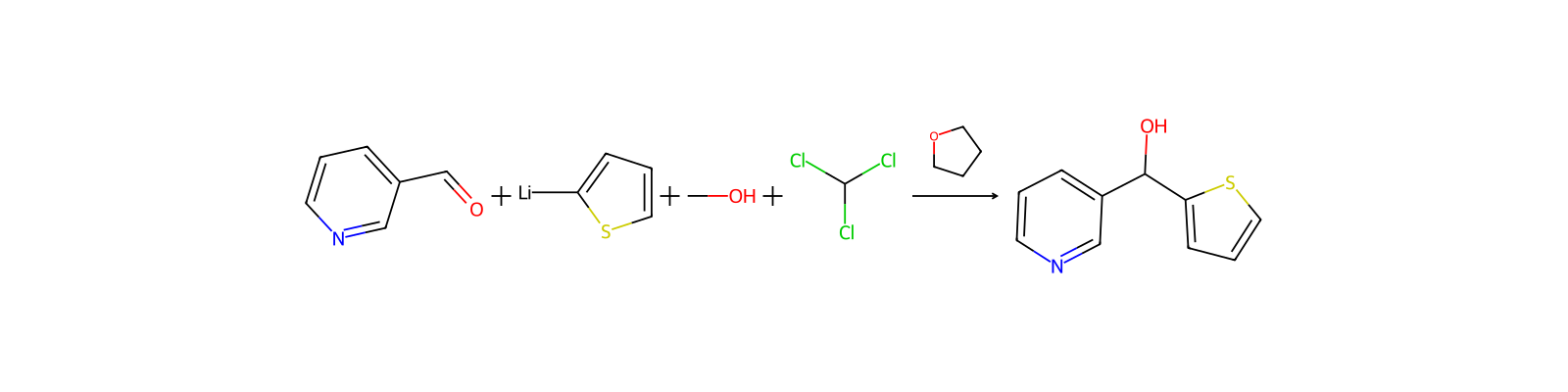
[N:1]1[CH:6]=[CH:5][CH:4]=[C:3]([CH:7]=[O:8])[CH:2]=1.[S:9]1[CH:13]=[CH:12][CH:11]=[C:10]1[Li].CO.C(Cl)(Cl)Cl>C1COCC1>[N:1]1[CH:6]=[CH:5][CH:4]=[C:3]([CH:7]([OH:8])[C:10]2[S:9][CH:13]=[CH:12][CH:11]=2)[CH:2]=1Participants
5
Reactant 3


Product 1

Reagents, catalysts & solvents 1

Conditions
- Temperature
- -78 °C
Procedure
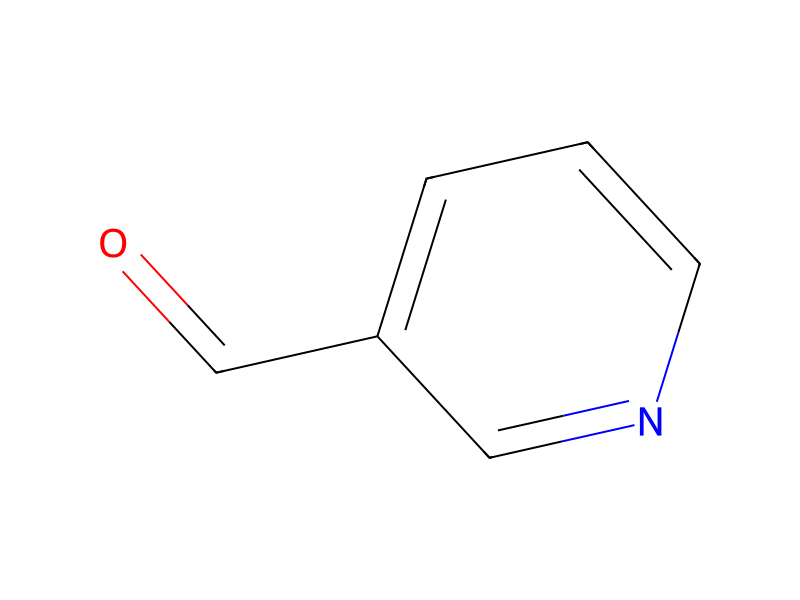
To a solution of 3-pyridinecarboxaldehyde (5.0 mL, 53 mmol) in THF at -78° C. was added 2-thienyllithium (1.0M in THF. 64 mL, 64 mmol) and the reaction mixture was stirred for 2 hours at -78° C. The reaction mixture was quenched with saturated aqueous NH4Cl and extracted with ether. The organic phase was dried over MgSO4, filtered, and concentrated in vacuo. Chromatography on silica gel (5%, then 10% methanol/CHCl3) gave 2-(3-pyridylhydroxymethyl)thiophene (6.30 g, 62% yield).
Workup
- customThe reaction mixture was quenched with saturated aqueous NH4Cl
- extractionextracted with ether
- dry with materialThe organic phase was dried over MgSO4
- filtrationfiltered
- concentrationconcentrated in vacuo
Sources & evidence
- ORD record
- ord-821002a002e645fc8b3d520076f6a82a
- Source dataset
- uspto-grants-1997_04
- Patent number
- US05616596
Linked notes
Loading…