Reaction equation

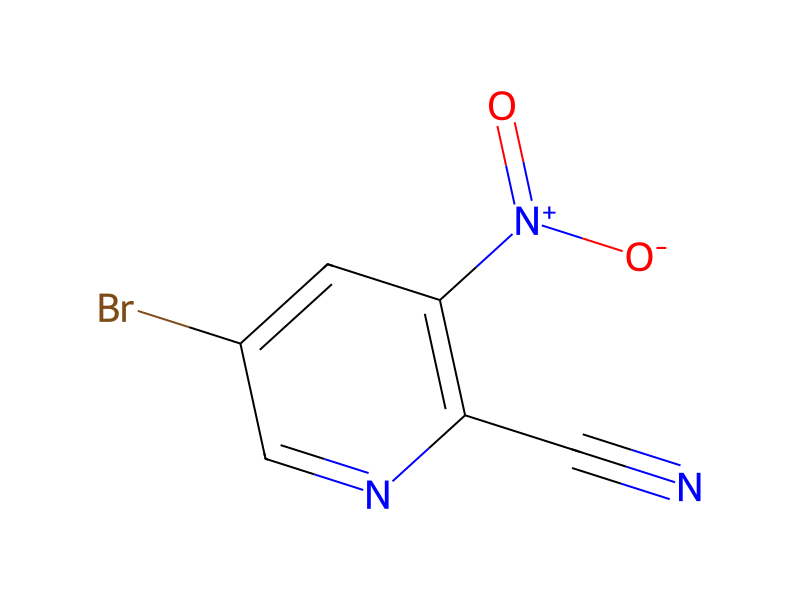
[CH3:1][N:2]1[C:6]([CH3:7])=[C:5]([OH:8])[C:4]([CH3:9])=[N:3]1.CN(C=O)C.O1CCOCC1.[H-].[Na+].[Br:23][C:24]1[CH:25]=[C:26]([N+]([O-])=O)[C:27]([C:30]#[N:31])=[N:28][CH:29]=1>O>[Br:23][C:24]1[CH:25]=[C:26]([O:8][C:5]2[C:4]([CH3:9])=[N:3][N:2]([CH3:1])[C:6]=2[CH3:7])[C:27]([C:30]#[N:31])=[N:28][CH:29]=1Participants
6
Reactant 4



Product 1

Reagents, catalysts & solvents 1

Conditions
- Temperature
- 0 °C
Procedure
A flask was charged with 1,3,5-trimethyl-1H-pyrazol-4-ol (10.46 g, 82.89 mmol), and DMF:dioxane (9:1) (700 mL). The reaction mixture was cooled to 0° C. and 60% sodium hydride (3.315 g, 82.89 mmol) was added portionwise. The reaction mixture was stirred for 15 minutes, and 5-bromo-3-nitropicolinonitrile (18 g, 78.95 mmol) was added. The reaction was stirred at ambient temperature for 3 hours, then poured slowly into 600 mL water and stirred for 10 minutes. The resultant solids were filtered and dried to afford 5-bromo-3-(1,3,5-trimethyl-1H-pyrazol-4-yloxy)picolinonitrile (23.70 g, 97.74% yield) as very lightly tan (white) solid.
Workup
- stirringThe reaction was stirred at ambient temperature for 3 hours
- stirringstirred for 10 minutes
- filtrationThe resultant solids were filtered
- customdried
Sources & evidence
- ORD record
- ord-817ab481f4c5422187b675760b23802f
- Source dataset
- uspto-grants-2014_10
- Patent number
- US08853409B2
Linked notes
Loading…