HomeMCPWorkbenchSkills
HomeWorkbenchNotificationsMe
llms.txt · MCP GuidePrivacy Policy · Terms of Service · Supportv1.8.0
  1. Home
  2. /Reaction

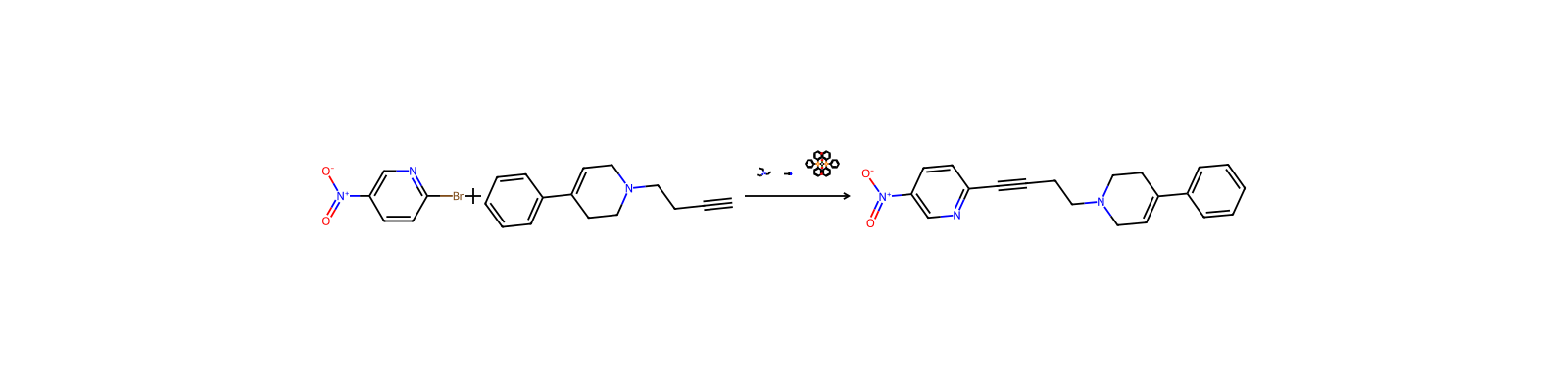
2-Bromo-5-nitropyridine → 1,2,3,6-Tetrahydro-1-[4-(5-nitro-2-pyridinyl)-3-butynyl]-4-phenylpyridine

HRID 53642
Notes
Print preview

Reaction equation

HRID 53642 reaction equation
Br[C:2]1[CH:7]=[CH:6][C:5]([N+:8]([O-:10])=[O:9])=[CH:4][N:3]=1.[C:11]1([C:17]2[CH2:18][CH2:19][N:20]([CH2:23][CH2:24][C:25]#[CH:26])[CH2:21][CH:22]=2)[CH:16]=[CH:15][CH:14]=[CH:13][CH:12]=1>C(N(CC)CC)C.C(#N)C.Cl[Pd](Cl)([P](C1C=CC=CC=1)(C1C=CC=CC=1)C1C=CC=CC=1)[P](C1C=CC=CC=1)(C1C=CC=CC=1)C1C=CC=CC=1>[N+:8]([C:5]1[CH:6]=[CH:7][C:2]([C:26]#[C:25][CH2:24][CH2:23][N:20]2[CH2:19][CH:18]=[C:17]([C:11]3[CH:16]=[CH:15][CH:14]=[CH:13][CH:12]=3)[CH2:22][CH2:21]2)=[N:3][CH:4]=1)([O-:10])=[O:9]
ParticipantsProcedureWorkupSources & evidenceReaction notes

Participants

6

Reactant 2

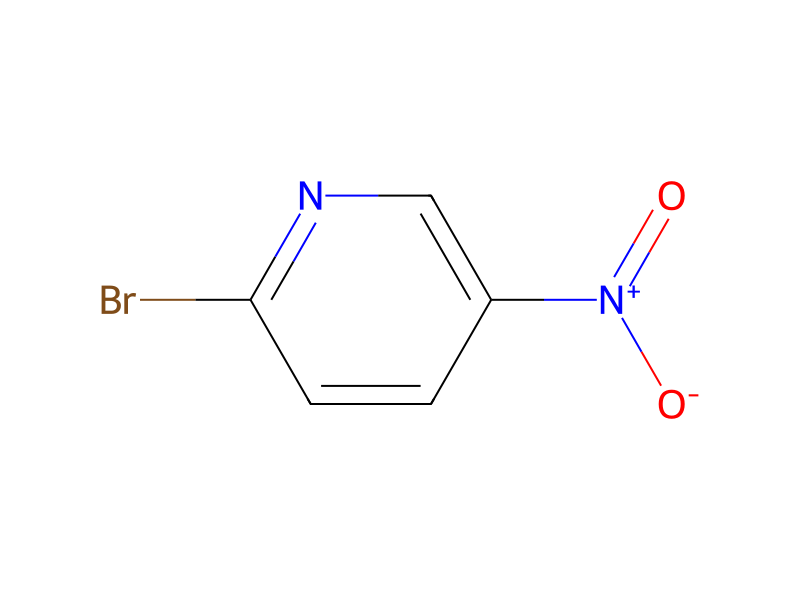
HCID 782402-Bromo-5-nitropyridineHCID 107985574-(3,6-Dihydro-4-phenyl-1(2H)-pyridinyl)-1-butyne

Product 1

HCID 106880901,2,3,6-Tetrahydro-1-[4-(5-nitro-2-pyridinyl)-3-butynyl]-4-phenylpyridine

Reagents, catalysts & solvents 3

HCID 178418476HCID 178418476, compoundCatalystHCID 6342AcetonitrileSolvent
HCID 8471TriethylamineSolvent

Procedure

A solution of 2-bromo-5-nitropyridine (4.23 g, 0.02 mol) and the alkyne prepared in Step (a) (4.0 g, 0.019 mol) in 7.9 mL of triethylamine and 100 mL of acetonitrile is degassed by bubbling in dry nitrogen for 15 minutes, and 0.27 g (0.0004 mol) of bis(triphenylphosphine)palladium chloride and 0.07 g (0.0004 mol) of cuprous iodide are added. The flask is flushed with nitrogen and the mixture is stirred at room temperature for 6 hours. The solvent is removed under reduced pressure and the residue is partitioned between 100 mL of dichloromethane and 100 mL of saturated aqueous sodium bicarbonate. The aqueous layer is extracted with 50 mL of dichloromethane and the combined organic layers are washed with 50 mL of water and dried (sodium sulfate), and the solvent is removed in vacuo. The residue is chromatographed (silica gel, 1% methanol/99% dichloromethane) to give the title compound, containing 0.3 mol of water; mp 133°-134° C.

Workup

  1. customby bubbling in dry nitrogen for 15 minutes
  2. customThe flask is flushed with nitrogen
  3. customThe solvent is removed under reduced pressure
  4. customthe residue is partitioned between 100 mL of dichloromethane and 100 mL of saturated aqueous sodium bicarbonate
  5. extractionThe aqueous layer is extracted with 50 mL of dichloromethane
  6. washthe combined organic layers are washed with 50 mL of water
  7. dry with materialdried (sodium sulfate)
  8. customthe solvent is removed in vacuo
  9. customThe residue is chromatographed (silica gel, 1% methanol/99% dichloromethane)

Sources & evidence

ORD record
ord-50743b3e0db3497584f798ee4c016561
Source dataset
uspto-grants-1997_04
DOI
10.6084/m9.figshare.5104873.v1
Patent number
US05620988

Reaction notes

Loading…

On this pageParticipantsProcedureWorkupSources & evidenceReaction notes