Reaction equation

[OH:1][C:2]1[CH:15]=[CH:14][C:13]2[C:12](=[O:16])[C:11]3[C:6](=[CH:7][CH:8]=[CH:9][CH:10]=3)[C:5](=[O:17])[C:4]=2[CH:3]=1.[H-].[Na+].[CH2:20]([CH:22]1[O:24][CH2:23]1)Cl.O>CN1CCCC1=O>[CH2:20]([O:1][C:2]1[CH:15]=[CH:14][C:13]2[C:12](=[O:16])[C:11]3[C:6](=[CH:7][CH:8]=[CH:9][CH:10]=3)[C:5](=[O:17])[C:4]=2[CH:3]=1)[CH:22]1[O:24][CH2:23]1Participants
Reactant 4


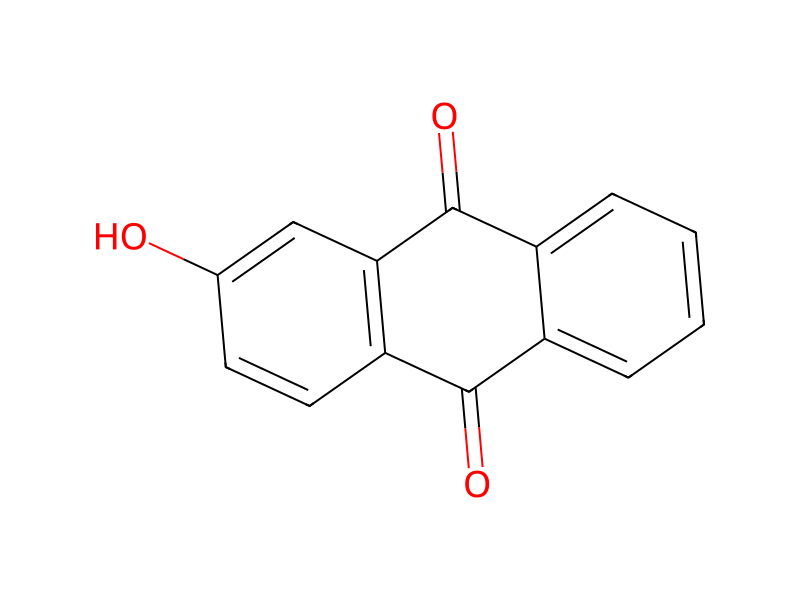

Product 1

Reagents, catalysts & solvents 1

Conditions
- Temperature
- 0 °C
Procedure
112.1 g (0.5 mole) of 2-hydroxyanthraquinone are dissolved in 500 ml of N-methylpyrrolidone, and 12 g (0.5 mole) of sodium hydride are added in portions. When the evolution of gas has ended, 46.37 ml (0.5 mole) of epichlorohydrin are added dropwise at 70° C. and stirring is continued at 70° C. for a further 8 hours. 1.5 liters of water are then added, the mixture is filtered and the filter cake is dried in vacuo. After drying, the product is boiled up again in 1 liter of N,N-dimethylformamide with 10 g of active charcoal and filtered hot. The crystals which precipitate on cooling to 0° C. are separated off by filtration and dried under a high vacuum. 69.45 g (50.57% of theory) of 2-anthraquinonyl glycidyl ether are obtained; melting point: 162°-167° C.
Workup
- filtrationthe mixture is filtered
- customthe filter cake is dried in vacuo
- customAfter drying
- filtrationfiltered hot
- customThe crystals which precipitate
- customare separated off by filtration
- customdried under a high vacuum
Sources & evidence
- ORD record
- ord-f1f5d4946bec4e9abeb9250e65294a87
- Source dataset
- uspto-grants-1987_04
- Patent number
- US04657842
Linked notes
Loading…