Reaction equation

[Br:1][C@@H:2]1[CH2:9][O:8][C@@H:4]([C:5]([OH:7])=O)[CH2:3]1.ON1C2C=CC=CC=2N=N1.[CH2:20]([O:27][C:28]([N:30]1[CH2:35][CH2:34][NH:33][CH2:32][CH2:31]1)=[O:29])[C:21]1[CH:26]=[CH:25][CH:24]=[CH:23][CH:22]=1.C1(N=C=NC2CCCCC2)CCCCC1>O.CN(C)C=O.C(Cl)Cl>[C:21]1([CH2:20][O:27][C:28]([N:30]2[CH2:35][CH2:34][N:33]([C:5]([C@@H:4]3[O:8][CH2:9][C@@H:2]([Br:1])[CH2:3]3)=[O:7])[CH2:32][CH2:31]2)=[O:29])[CH:26]=[CH:25][CH:24]=[CH:23][CH:22]=1Participants
8
Reactant 4


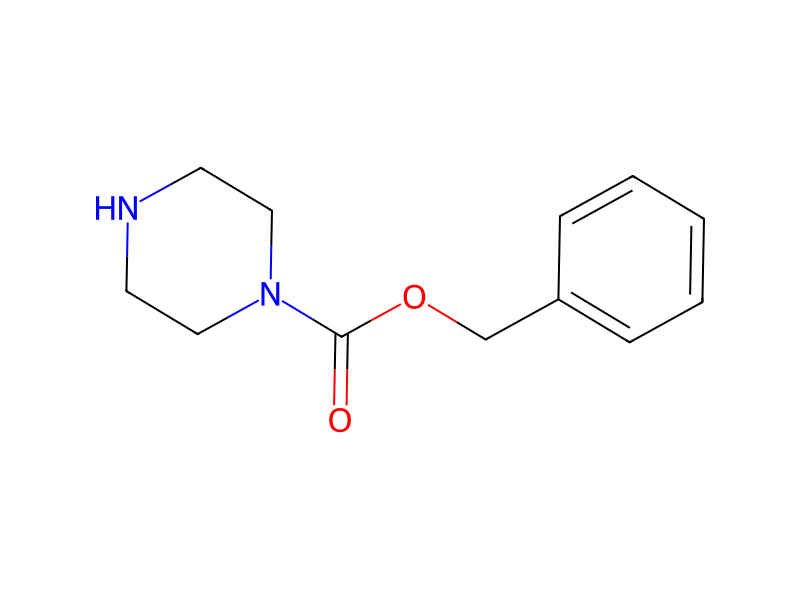

Product 1

Reagents, catalysts & solvents 3



Procedure
A mixture of 0.941 g of product from Example 150, 0.652 g of 1-hydroxybenzotriazole, 1.17 g of 1-benzyloxycarbonyl piperazine, 1.39 g of dicyclohexylcarbodiimide and 8 ml of dry methylene chloride is stirred at room temperature for 1 hour. Five ml of dimethylformamide is added and the stirring continued overnight at room temperature. The reaction mixture is diluted with water and extracted with chloroform. The organic layer is dried, concentrated in vacuo and the residue purified by chromatography (silica gel: 10-80% ethyl acetate/hexane) to give 1.1 g of the desired product.
Workup
- customthe stirring continued overnight
- customat room temperature
- extractionextracted with chloroform
- customThe organic layer is dried
- concentrationconcentrated in vacuo
- customthe residue purified by chromatography (silica gel: 10-80% ethyl acetate/hexane)
Sources & evidence
- ORD record
- ord-d23b9cb991464243b285bc1e2e58ccff
- Source dataset
- uspto-grants-1997_04
- Patent number
- US05623081
Linked notes
Loading…