Reaction equation
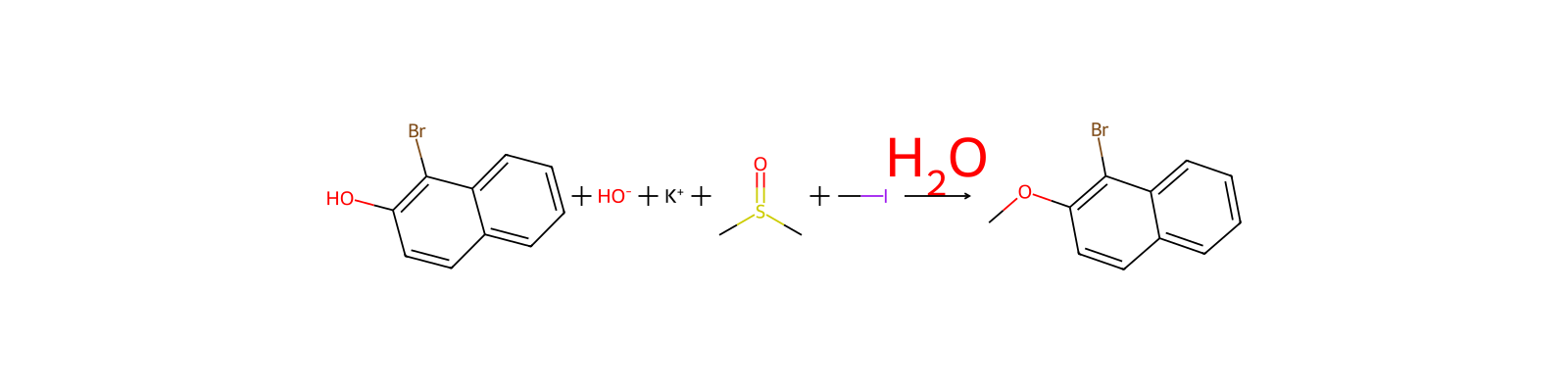
[Br:1][C:2]1[C:11]2[C:6](=[CH:7][CH:8]=[CH:9][CH:10]=2)[CH:5]=[CH:4][C:3]=1[OH:12].[OH-].[K+].[CH3:15]S(C)=O.IC>O>[Br:1][C:2]1[C:11]2[C:6](=[CH:7][CH:8]=[CH:9][CH:10]=2)[CH:5]=[CH:4][C:3]=1[O:12][CH3:15]Participants
Reactant 4


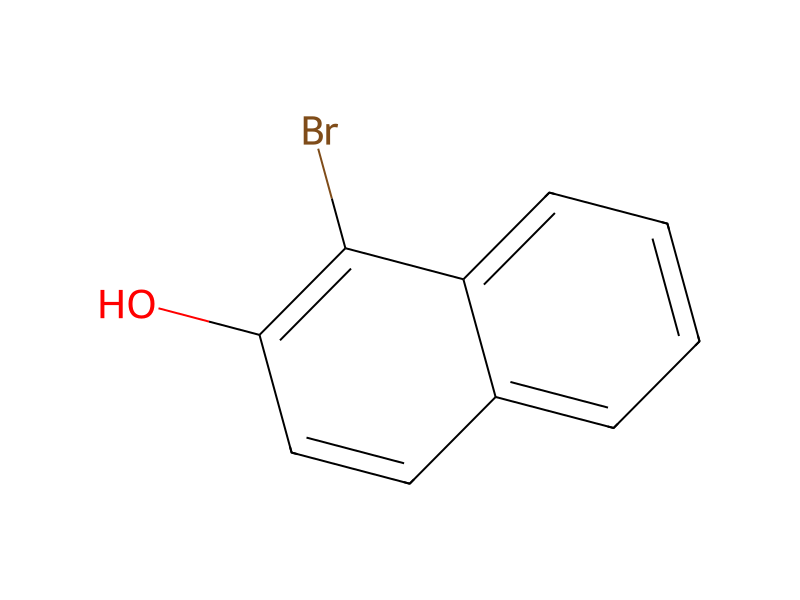

Product 1
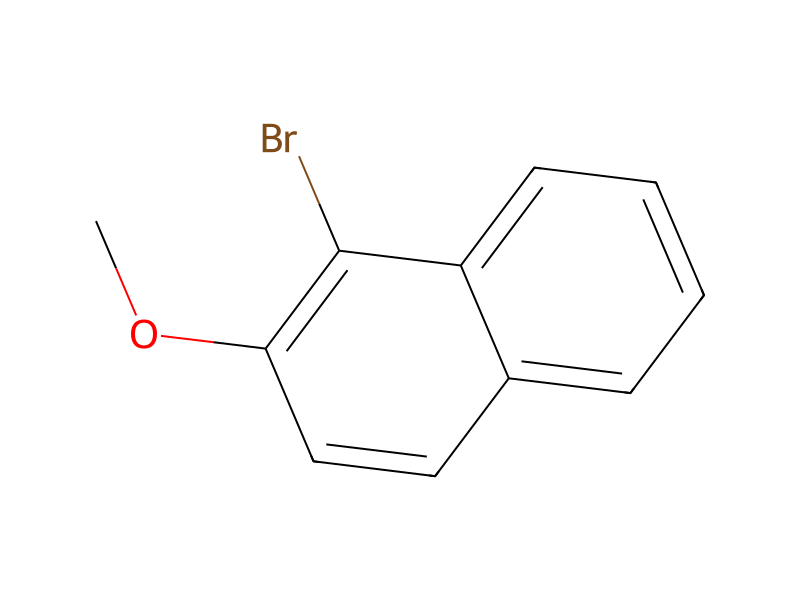
Reagents, catalysts & solvents 1

Procedure
A 500 mL three-necked round-bottomed flask was charged with 1-bromonaphthalen-2-ol (30.0 g, 134.5 mmol), potassium hydroxide (KOH) (11.3 g, 201.7 mmol) and DMSO (300 mL), and the mixture was stirred under nitrogen atmosphere for 10 minutes, After cooling the mixture by using ice-water bath, iodomethane (28.6 g, 201.7 mmol) was slowly added dropwise thereto. Then, the resultant mixture was stirred under nitrogen atmosphere at ambient temperature for 12 hours, and then at 50° C. for 1 hour. After cooling to ambient temperature, the reaction mixture was mixed with water (500 mL), and extracted with diethyl ether. Organic mixture was washed three times with distilled water, and dried over anhydrous magnesium sulfate (MgSO4). After removing the solvent by using a rotary evaporator, the residue was purified via silica gel column chromatography (eluent: n-hexane) to obtain 1-bromo-2-methoxynaphthalene (22.0 g, yield: 69.0%) as white solid.
Workup
- temperatureAfter cooling the mixture
- waitat 50° C. for 1 hour
- extractionextracted with diethyl ether
- washOrganic mixture was washed three times with distilled water
- dry with materialdried over anhydrous magnesium sulfate (MgSO4)
- customAfter removing the solvent
- customa rotary evaporator
- customthe residue was purified via silica gel column chromatography (eluent: n-hexane)
Sources & evidence
- ORD record
- ord-5f3bba70d52444a189792b56345d99b6
- Source dataset
- uspto-grants-2011_11
- Patent number
- US08067511B2
Linked notes
Loading…