Reaction equation

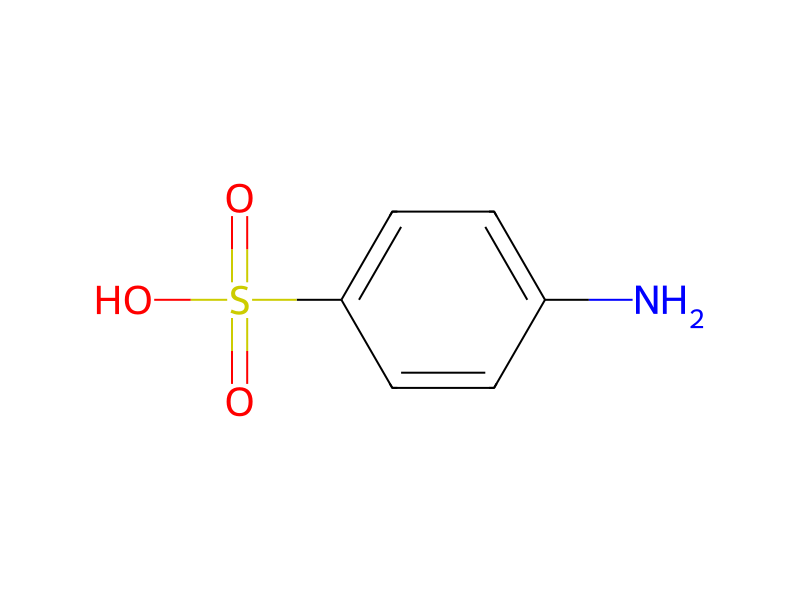
[S:1]([OH:11])(=[O:10])([C:3]1[CH:8]=[CH:7][C:6]([NH2:9])=[CH:5][CH:4]=1)=[O:2].Cl[C:13]1[C:22]2[C:17](=[CH:18][C:19]([C:23]([F:26])([F:25])[F:24])=[CH:20][CH:21]=2)[N:16]=[CH:15][N:14]=1>C(O)C>[F:26][C:23]([F:24])([F:25])[C:19]1[CH:18]=[C:17]2[C:22]([C:13]([NH:9][C:6]3[CH:5]=[CH:4][C:3]([S:1]([OH:11])(=[O:10])=[O:2])=[CH:8][CH:7]=3)=[N:14][CH:15]=[N:16]2)=[CH:21][CH:20]=1Participants
4
Reactant 2

Product 1

Reagents, catalysts & solvents 1

Procedure
0.8 grams of sulphanilic acid and an equimolar quantity of 4-chloro-7-trifluoromethylquinazoline were heated in 20 ml of 50% aqueous ethanol at 100° C. for 2 hours. The suspension was cooled and the solid was filtered off, washed with water and dried to give 1.03 g of the title compound. The sulphonyl chloride hydrochloride derivative for use in part (b) below was prepared in similar manner to Examples 1 and 2.
Workup
- temperatureThe suspension was cooled
- filtrationthe solid was filtered off
- washwashed with water
- customdried
Sources & evidence
- ORD record
- ord-3cc09cb01b2549f79075c586a530f048
- Source dataset
- uspto-grants-1988_03
- Patent number
- US04734510
Linked notes
Loading…