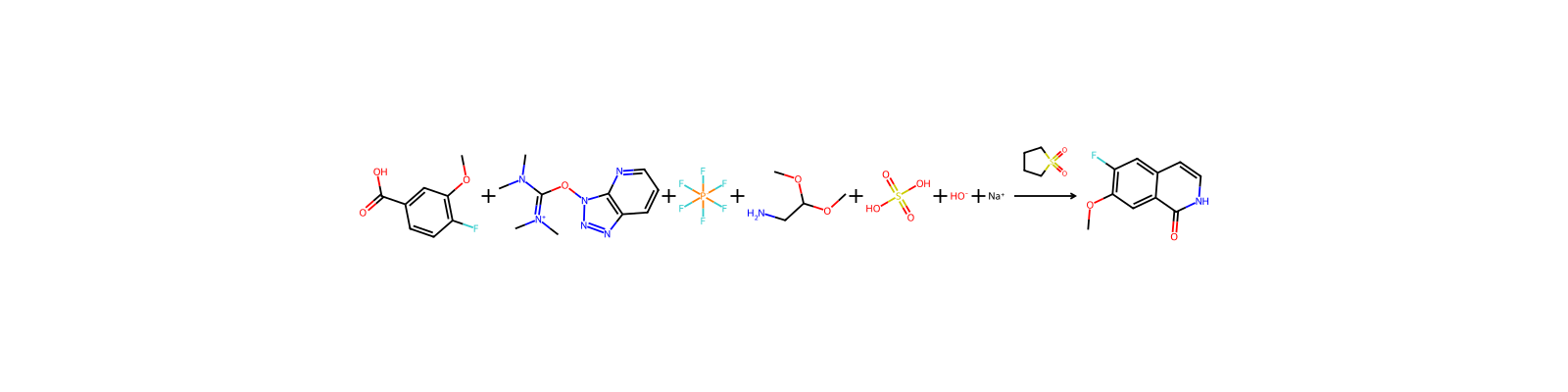
[F:1][C:2]1[CH:10]=[CH:9][C:5]([C:6]([OH:8])=O)=[CH:4][C:3]=1[O:11][CH3:12].CN(C(O[N:21]1N=N[C:23]2C=CC=N[C:22]1=2)=[N+](C)C)C.F[P-](F)(F)(F)(F)F.COC(OC)CN.OS(O)(=O)=O.[OH-].[Na+]>S1(CCCC1)(=O)=O>[F:1][C:2]1[CH:10]=[C:9]2[C:5](=[CH:4][C:3]=1[O:11][CH3:12])[C:6](=[O:8])[NH:21][CH:22]=[CH:23]2A solution of 4-fluoro-3-methoxybenzoic acid (1.30 g, 7.64 mmol) and TEA (1.25 mL, 8.97 mmol) in sulfolane (6.0 mL) was treated with HATU (3.25 g, 8.55 mmol). After 10 minutes, aminoacetaldehyde dimethylacetal (0.925 mL, 8.58 mmol) was added. The reaction mixture was stirred at room temperature for 30 minutes. The reaction mixture was then treated with conc. H2SO4 (15 mL) and stirred at 60° C. for 2 days. The reaction mixture was poured over ice and brought to pH˜4 with 10M NaOH (˜55 mL). The precipitate was collected by filtration, washed with water, and dried under vacuum to give 6-fluoro-7-methoxyisoquinolin-1(2H)-one (Cpd L, 1.32 g, 89%) as a white powder.