Reaction equation
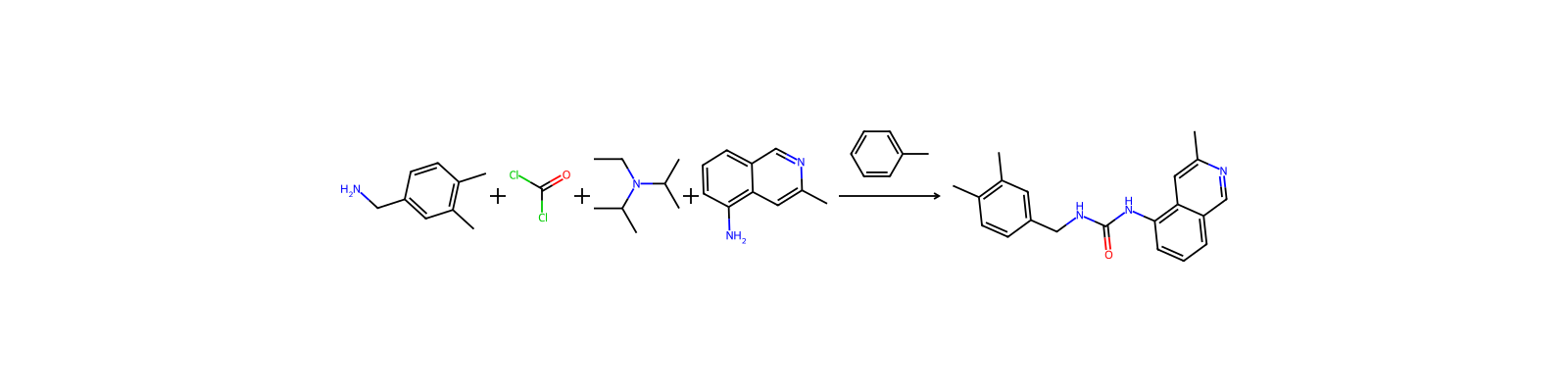
[CH3:1][C:2]1[CH:3]=[C:4]([CH:7]=[CH:8][C:9]=1[CH3:10])[CH2:5][NH2:6].[C:11](Cl)(Cl)=[O:12].CCN(C(C)C)C(C)C.[NH2:24][C:25]1[CH:34]=[CH:33][CH:32]=[C:31]2[C:26]=1[CH:27]=[C:28]([CH3:35])[N:29]=[CH:30]2>C1(C)C=CC=CC=1>[CH3:1][C:2]1[CH:3]=[C:4]([CH:7]=[CH:8][C:9]=1[CH3:10])[CH2:5][NH:6][C:11]([NH:24][C:25]1[CH:34]=[CH:33][CH:32]=[C:31]2[C:26]=1[CH:27]=[C:28]([CH3:35])[N:29]=[CH:30]2)=[O:12]Participants






Procedure
3,4-Dimethylbenzylamine (0.3 mL, 2.1 mmol) in toluene (11 mL) was added carefully to a 20% w/v solution of phosgene in toluene (4.5 mL). The mixture was refluxed overnight and was then concentrated in vacuo. The residue was then taken up in toluene (10 mL) and treated with DIEA (1.5 mL, 8.63 mmol) and 5-amino-3-methylisoquinoline (155 mg, 1.08 mmol). The reaction mixture was stirred at 80° for 2 h and was then cooled to room temperature. The precipitated solid was collected by filtration and was chromatographed on silica gel (97:3 CH2Cl2—CH3OH to 9:1 CH2Cl2—CH3OH, eluant gradient) to afford the desired product, A-473191. Treatment of this solid with methanolic HCl yielded the corresponding hydrochloride salt. 1H NMR (300 MHz, DMSO-d6) δ 9.16 (s, 1H), 8.59 (s, 1H), 8.24 (d, 1H, J=7.8 Hz), 7.74 (s, 1H), 7.68 (d, 1H, J=8.2 Hz), 7.50 (t, 1H, J=7.9 Hz), 7.08-7.12 (m, 3H), 6.95 (m, 1H), 4.28 (d, 2H, 5.8 Hz), 2.64 (s, 3H), 2.22 (s, 3H), 2.20 (s, 3H); MS (ESI+) m/z 320 (M+H).
Workup
- temperatureThe mixture was refluxed overnight
- concentrationwas then concentrated in vacuo
- filtrationThe precipitated solid was collected by filtration
- customwas chromatographed on silica gel (97:3 CH2Cl2—CH3OH to 9:1 CH2Cl2—CH3OH, eluant gradient)
Sources & evidence
- ORD record
- ord-f6b5a55bb2814050820a8d2b82986a16
- Source dataset
- uspto-grants-2005_08
- Patent number
- US06933311B2
Linked notes
Loading…