Reaction equation
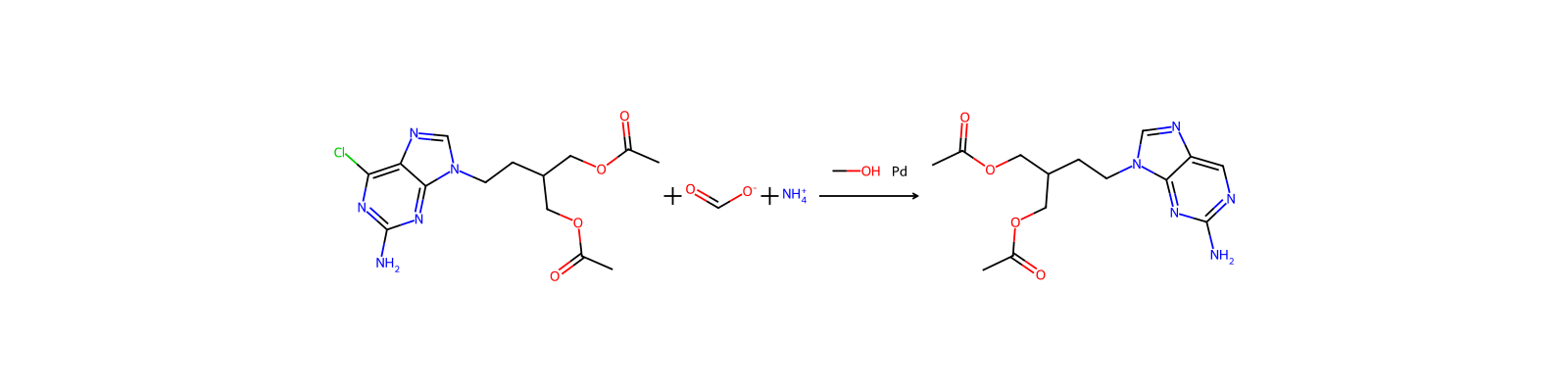
[C:1]([O:4][CH2:5][CH:6]([CH2:20][O:21][C:22](=[O:24])[CH3:23])[CH2:7][CH2:8][N:9]1[CH:17]=[N:16][C:15]2[C:10]1=[N:11][C:12]([NH2:19])=[N:13][C:14]=2Cl)(=[O:3])[CH3:2].C([O-])=O.[NH4+]>CO.[Pd]>[C:1]([O:4][CH2:5][CH:6]([CH2:20][O:21][C:22](=[O:24])[CH3:23])[CH2:7][CH2:8][N:9]1[CH:17]=[N:16][C:15]2[C:10]1=[N:11][C:12]([NH2:19])=[N:13][CH:14]=2)(=[O:3])[CH3:2]Participants
Reactant 2

Product 1

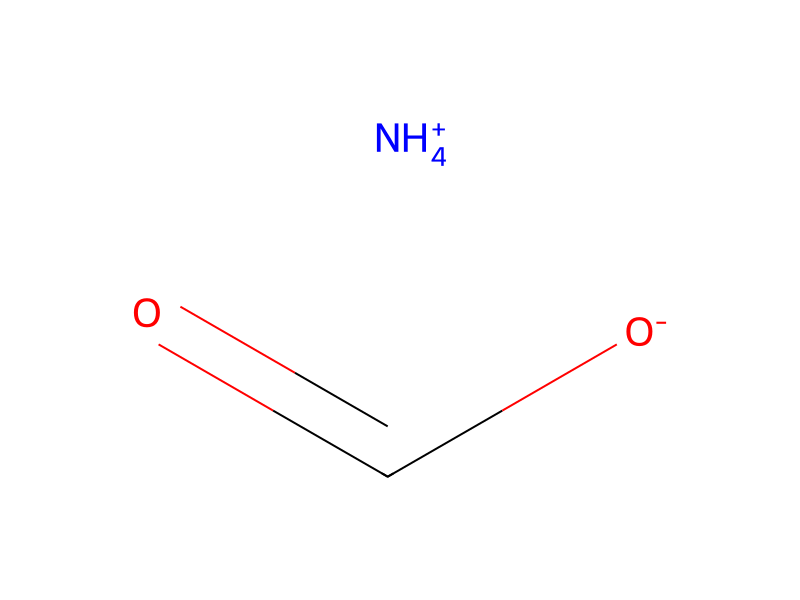
Reagents, catalysts & solvents 2


Procedure
A suspension of 9-(4-acetoxy-3-acetoxymethylbut-1-yl)-2-amino-6-chloropurine (0.36 g, 1.0 mmol) and 10% palladium-on-charcoal (30 mg) in methanol containing ammonium formate (400 mM, 10 ml) was heated under reflux for 30 minutes. The mixture was allowed to cool, filtered and the solvent removed. The residue was taken up in water and the solution extracted twice with chloroform. The organic layers were combined, dried (magnesium sulphate) and the solvent removed to afford 9-(4-acetoxy-3-acetoxymethylbut-1-yl)-2-aminopurine (0.29 g, 90%). Recrystallisation from ethyl acetate-hexane gave white shiny plates (0.25 g, 78%) m.p. 102°-104° C.; λmax (MeOH) 222 (27,500), 244 (4,890), and 309 (7,160) nm; νmax (KBr) 3340, 3170, 1745, 1730, 1660, 1615 and 1580 cm-1 ; δH (CDCl3) 1.90-2.05 (3H, m, 2'-H and 3' -H), 2.07 (6H, s, 2×CH3), 4.15 (4H, d, J 5.2 Hz, 2×4'-H), 4.21 (2H, t, J 7.2 Hz, 1'-H), 5.16 (2H, br s, 2-NH2), 7.79 (1H, s, 8-H), and 8.70 (1H, s, 6-H); (Found: C, 52.10; H, 6.00; N, 21.49%. C14H19N5O4 requires C, 52.33; H, 5.96; N, 21.79%).
Workup
- temperaturewas heated
- temperatureunder reflux for 30 minutes
- temperatureto cool
- filtrationfiltered
- customthe solvent removed
- extractionthe solution extracted twice with chloroform
- dry with materialdried (magnesium sulphate)
- customthe solvent removed
Sources & evidence
- ORD record
- ord-4433a99e49994b5fbc65a69fbcc99e86
- Source dataset
- uspto-grants-1993_09
- Patent number
- US05246937
Linked notes
Loading…