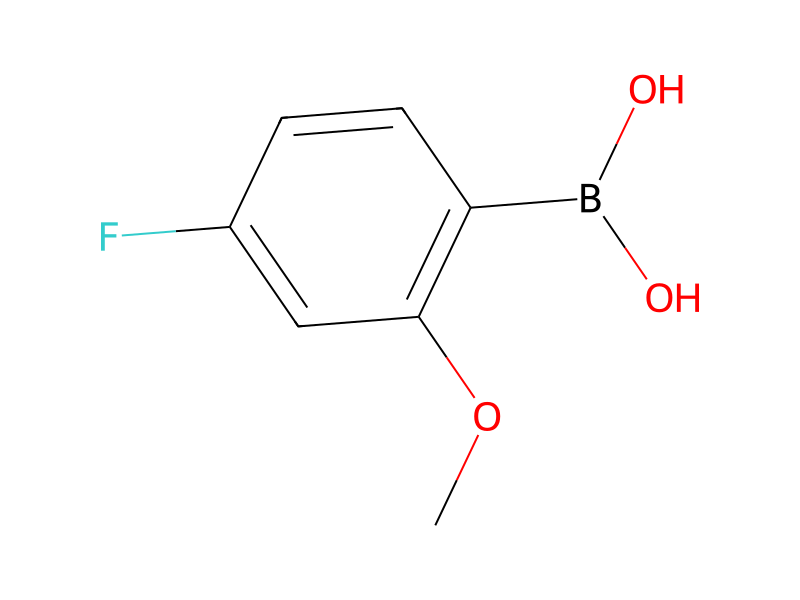
Br[C:2]1[CH:7]=[CH:6][N:5]=[C:4]([Cl:8])[CH:3]=1.[F:9][C:10]1[CH:15]=[CH:14][C:13](B(O)O)=[C:12]([O:19][CH3:20])[CH:11]=1.[O-]P([O-])([O-])=O.[K+].[K+].[K+]>O1CCOCC1.O.CCOC(C)=O.C1C=CC(P(C2C=CC=CC=2)[C-]2C=CC=C2)=CC=1.C1C=CC(P(C2C=CC=CC=2)[C-]2C=CC=C2)=CC=1.Cl[Pd]Cl.[Fe+2]>[Cl:8][C:4]1[CH:3]=[C:2]([C:13]2[CH:14]=[CH:15][C:10]([F:9])=[CH:11][C:12]=2[O:19][CH3:20])[CH:7]=[CH:6][N:5]=1A mixture of 4-bromo-2-chloropyridine (1.92 g, 10 mmol), (4-fluoro-2-methoxyphenyl)boronic acid (1.70 g, 10 mmol) and K3PO4 (4.24 g, 20 mmol) in dioxane/water 10:1 (20 mL) was degassed with a stream of nitrogen for 10 min. After addition of Pd(dppf)Cl2 (816 mg, 1 mmol) the reaction mixture was heated at 145° C. for 90 minutes in a microwave oven. It was diluted with EtOAc and washed twice with sat. aq. NaHCO3 solution and once with brine. The organic layer was dried over MgSO4 and concentrated under reduced pressure. The residue was purified by flash chromatography on silica gel (cHex/EtOAc 100:0 to 60:40) to yield the desired product A2 as a white solid (1.07 g, 45%). 1H NMR (400 MHz, d6-DMSO, 300K) δ 3.81 (s, 3H), 6.87 (dt, J=8.5 Hz, J=3.5 Hz, 1H), 7.05 (dd, J=11.4 Hz, J=2.5 Hz, 1H), 7.44 (dd, J=8.5 Hz, J=6.8 Hz, 1H), 7.48 (dd, J=5.3 Hz, J=1.5 Hz, 1H), 7.55 (m, 1H), 8.38 (d, J=5.3 Hz, 1H). MS (ES) C12H9ClFNO requires: 237. found: 238 (M+H)+.