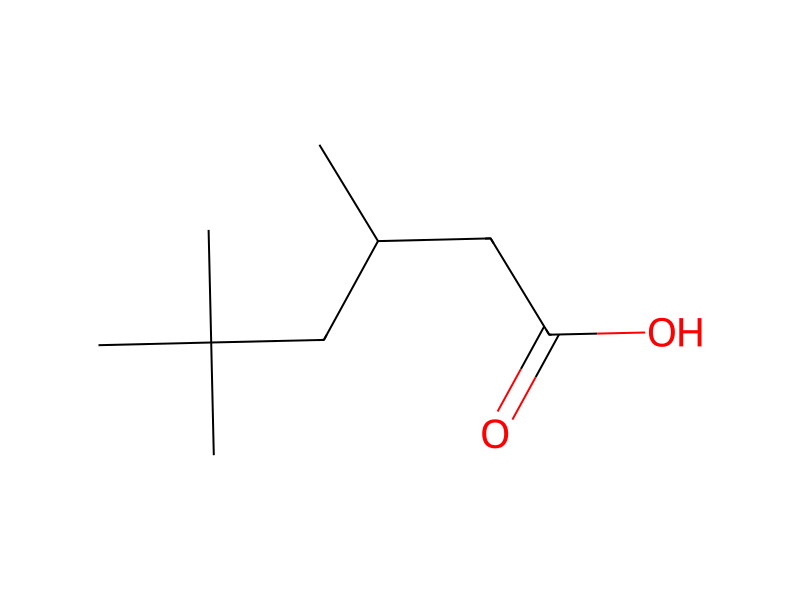
A 1 L four-necked flask equipped with a stirrer, a thermometer and a water-fractionating receiver with a cooling tube was charged with 483.5 g (3.06 mol) of 3,5,5-trimethylhexanoic acid, 216 g (1.5 mol) of 1,4-cyclohexane dimethanol (produced by hydrogenating a nucleus of dimethyl terephthalate in the presence of a ruthenium-supporting molded catalyst to obtain dimethyl 1,4-cyclohexanedicarboxylate, and then hydrogenating the thus obtained dimethyl 1,4-cyclohexanedicarboxylate in the presence of a copper-chromium molded catalyst), xylene (5% by weight on the basis of a total weight of the raw materials), and tin oxide as a catalyst (0.2% by weight on the basis of a total weight of the raw materials), and the contents of the flask were gradually heated to 220° C. under a nitrogen atmosphere. Then, the contents of the flask were subjected to esterification reaction under reduced pressure for about 8 h while removing water distilled off by the water-fractionating receiver until reaching a theoretical amount (72 g) thereof. After completion of the reaction, an excess amount of the acid was removed by distillation. Next, the resultant esterification reaction product was neutralized with an aqueous sodium hydroxide solution which was used in an excess amount relative to a total acid value of the esterification reaction product, and then washed with water until reaching a neutrality, thereby obtaining a crude esterification reaction product. Further, the thus obtained crude esterification reaction product was treated with activated carbon, and then filtered to obtain 568 g of 1,4-cyclohexane dimethanol di(3,5,5-trimethylhexanoate) (Compound 4). It was confirmed that the resultant ester had a total acid value of 0.01 mg KOH/g, an iodine number of less than 0.1 I2g/100 g and a molar ratio of cis-isomer to trans-isomer of 29/71. Various properties of the thus obtained compound 4 such as coefficient of traction, kinematic viscosity, viscosity index (VI), flash point and pour point thereof, are shown in Table 1.