Reaction equation

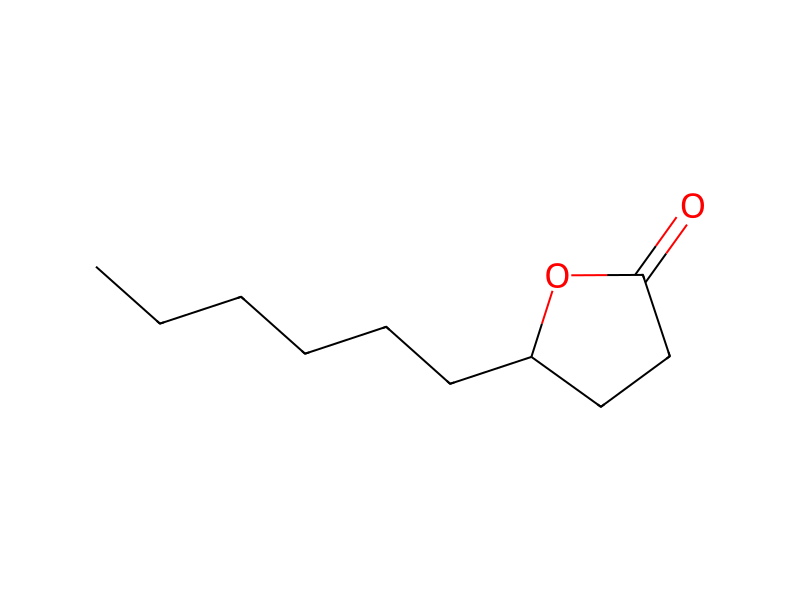
O=[C:2]([CH2:12][CH2:13][CH2:14][CH2:15][CH2:16][CH3:17])[CH2:3][CH2:4][C:5]([O:7]CC(C)C)=[O:6].[BH4-].[Na+].O.C(OCC)(=O)C>C(O)C>[CH3:17][CH2:16][CH2:15][CH2:14][CH2:13][CH2:12][CH:2]1[O:7][C:5](=[O:6])[CH2:4][CH2:3]1Participants
Reactant 4




Product 1
Reagents, catalysts & solvents 1

Conditions
- Temperature
- 25 °C
Procedure
In 200 ml of 99.5% ethanol, was dissolved 24.2 g (0.10 mol) of isobutyl 4-oxodecanoate. Thereto was added 4.2 g (0.11 mol) of sodium borohydride in small quantities, and then the mixture was stirred for 10 minutes at 25° C. The solution was poured into 1 L of water, and 1 L of ethyl acetate was further added thereto followed by stirring to thereby extract the product into the ethyl acetate phase. Ethyl acetate was distilled off followed by vacuum distillation, yielding γ-decalactone (a compound in which R61 represents an n-pentyl group in the above formula (39)). Gas chromatographic analysis showed that the yield of γ-decalactone relative to isobutyl 4-oxodecanoate was 93%. In the resulting γ-decalactone, a plastic-like flavor or acid taste was not observed at all, but it had a good peach-like aroma.
Workup
- additionwas further added
- stirringby stirring
- extractionto thereby extract the product into the ethyl acetate phase
- distillationEthyl acetate was distilled off
- distillationfollowed by vacuum distillation
Sources & evidence
- ORD record
- ord-86533efc566141899f7c59d449285252
- Source dataset
- uspto-grants-2011_03
- Patent number
- US07897802B2
Linked notes
Loading…