Reaction equation
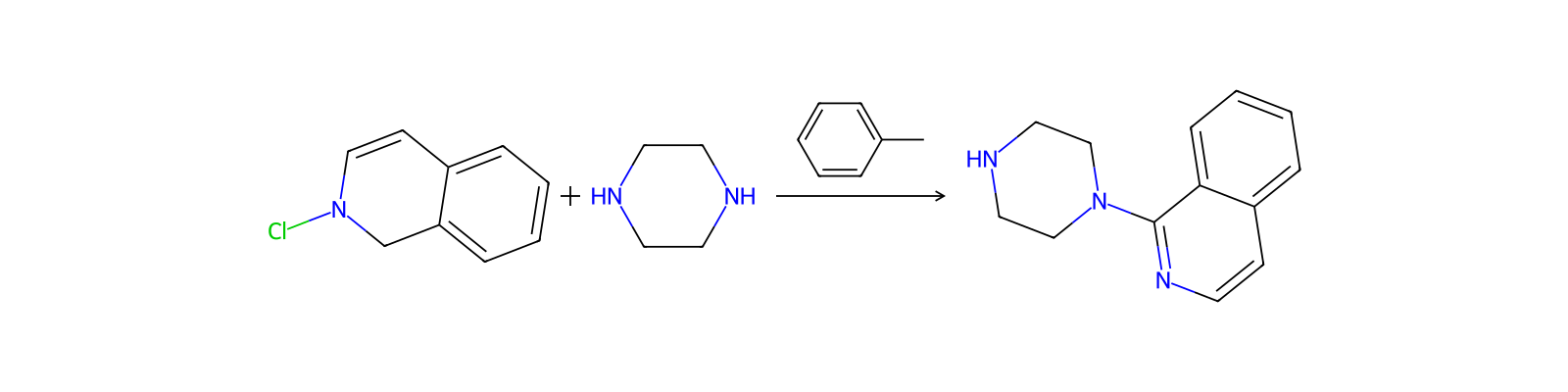
Cl[N:2]1[CH:11]=[CH:10][C:9]2[C:4](=[CH:5][CH:6]=[CH:7][CH:8]=2)[CH2:3]1.[NH:12]1[CH2:17][CH2:16][NH:15][CH2:14][CH2:13]1>C1(C)C=CC=CC=1>[C:3]1([N:12]2[CH2:17][CH2:16][NH:15][CH2:14][CH2:13]2)[C:4]2[C:9](=[CH:8][CH:7]=[CH:6][CH:5]=2)[CH:10]=[CH:11][N:2]=1Participants
Reactant 2


Product 1

Reagents, catalysts & solvents 1

Conditions
- Temperature
- 0 °C
Procedure
A solution of 2-chloroisoquinoline (5 g) in 20 mL of toluene is added dropwise to a refluxing solution of piperazine (20 g) in 150 mL of toluene. The solution is heated for an additional 48 h. After cooling to 0° C. for 0.5 h, the solution is filtered. The filtrate is then extracted with 10% acetic acid. The aqueous extracts are washed with ether, basified and subsequently extracted with dichloromethane. The dichloromethane layer is finally washed with water, dried and concentrated. The material is placed under vacuum overnight to yield the title compound (6.8 g, m.p. 54-56° C.). 1H NMR (CDCl3) 8.14 (d, J=5.5 Hz, 1 H), 8.10 (d, J=8.5 Hz, 1 H), 7.74 (d, J=8.5 Hz, 1 H), 7.60 (t, J=7.2 Hz, 1 H), 7.50 (t, J=7.6 Hz, 1 H), 7.24 (d, J=5.5 Hz, 1 H), 3.39 (t, J=5.0Hz, 4 H), 3.16 (t, J=5.0Hz, 4 H).
Workup
- temperatureThe solution is heated for an additional 48 h
- filtrationthe solution is filtered
- extractionThe filtrate is then extracted with 10% acetic acid
- washThe aqueous extracts are washed with ether
- extractionbasified and subsequently extracted with dichloromethane
- washThe dichloromethane layer is finally washed with water
- customdried
- concentrationconcentrated
- customis placed under vacuum overnight
Sources & evidence
- ORD record
- ord-c9ee6016525a4416b294225135796a3c
- Source dataset
- uspto-grants-1999_12
- Patent number
- US06008352
Linked notes
Loading…