Reaction equation
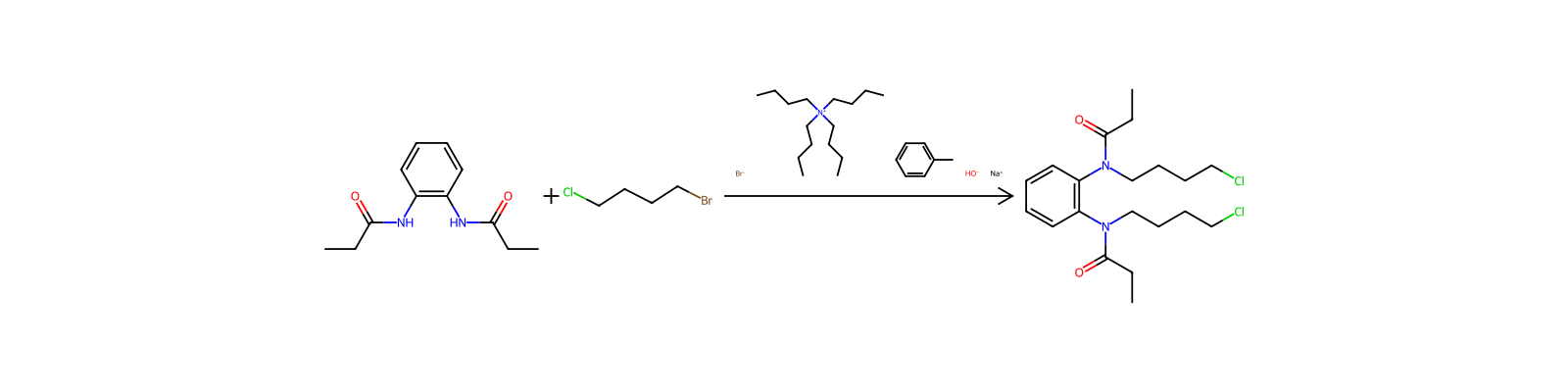
[C:1]([NH:5][C:6]1[CH:11]=[CH:10][CH:9]=[CH:8][C:7]=1[NH:12][C:13](=[O:16])[CH2:14][CH3:15])(=[O:4])[CH2:2][CH3:3].Br[CH2:18][CH2:19][CH2:20][CH2:21][Cl:22]>[Br-].C([N+](CCCC)(CCCC)CCCC)CCC.C1(C)C=CC=CC=1.[OH-].[Na+]>[Cl:22][CH2:21][CH2:20][CH2:19][CH2:18][N:5]([C:6]1[CH:11]=[CH:10][CH:9]=[CH:8][C:7]=1[N:12]([C:13](=[O:16])[CH2:14][CH3:15])[CH2:18][CH2:19][CH2:20][CH2:21][Cl:22])[C:1](=[O:4])[CH2:2][CH3:3]Participants
6
Reactant 2


Product 1

Reagents, catalysts & solvents 3



Procedure
To a suspension of 3.27 g (15 mmol) of 1,2-di-propionylaminobenzene, 4.32 ml (37.5 mmol) of 4-bromo-1-chlorobutane, and 0.96 g (3.0 mmol) of tetrabutylammonium bromide in 25 ml of toluene, 5.6 ml of 50% aqueous sodium hydroxide was added at room temperature, and the mixture was stirred for 16 hours. The organic layer was separated, washed with saturated aqueous sodium chloride, and dried. The solvent was distilled off and the residue was purified by column chromatography (eluent: hexane/ethyl acetate =2 :1 to 1:1 to 1:2 to 1:4) to give 0.76 g of the desired product (12.6% yield, white crystals).
Workup
- additionwas added at room temperature
- customThe organic layer was separated
- washwashed with saturated aqueous sodium chloride
- customdried
- distillationThe solvent was distilled off
- customthe residue was purified by column chromatography (eluent: hexane/ethyl acetate =2 :1 to 1:1 to 1:2 to 1:4)
Sources & evidence
- ORD record
- ord-100d3d0cc94243f9be6bff4a345d975c
- Source dataset
- uspto-grants-1993_09
- Patent number
- US05246948
Linked notes
Loading…