Reaction equation

[C:1]1([NH:7][C:8]2[CH:13]=[CH:12][CH:11]=[CH:10][CH:9]=2)[CH:6]=[CH:5][CH:4]=[CH:3][CH:2]=1.[CH3:14][N:15]=[C:16]=[O:17].P([O-])(OCCCC)(OCCCC)=O>C1(C)C=CC=CC=1>[CH3:14][NH:15][C:16]([N:7]([C:1]1[CH:2]=[CH:3][CH:4]=[CH:5][CH:6]=1)[C:8]1[CH:9]=[CH:10][CH:11]=[CH:12][CH:13]=1)=[O:17]Participants
Reactant 3
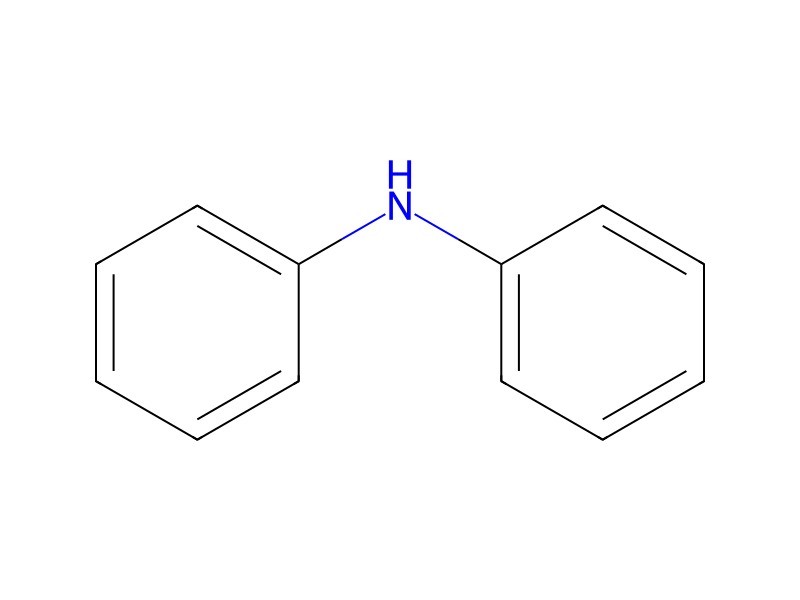


Product 1

Reagents, catalysts & solvents 1

Conditions
- Temperature
- 100 °C
Procedure
0.5 mole of diphenylamine was taken together with 0.53 mole of methyl isocyanate and 0,6 g of di-n-butyl phosphate in 150 ml of toluene. The mixture was heated at 100° C. for 10 hours, with stirring. After cooling to room temperature, the N-methyl-N',N'-diphenylurea formed was filtered off wtih suction. The filtrate was made up to 150 ml with toluene, and 0.5 mole of diphenylamine and 0.53 mole of methyl isocyanate were added. The mixture was heated again at 100° C. for 10 hours, with stirring, and then cooled to room temperature. Recycling of the filtrate and subsequent addition of in each case 0.5 mole of diphenylamine and 0.53 mole of methyl isocyanate was repeated a further three times. After these five reactions with only a single addition of catalyst, 2.4 moles of N-methyl-N',N'-diphenylurea were obtained. The urea was washed with in each case 100 ml of cold toluene after each reaction. Melting point: 170°/yield: 96% of theory.
Workup
- temperatureAfter cooling to room temperature
Sources & evidence
- ORD record
- ord-b3d203af496c4f21a41ee1f821f7ab01
- Source dataset
- uspto-grants-1989_04
- Patent number
- US04820871
Linked notes
Loading…