Reaction equation

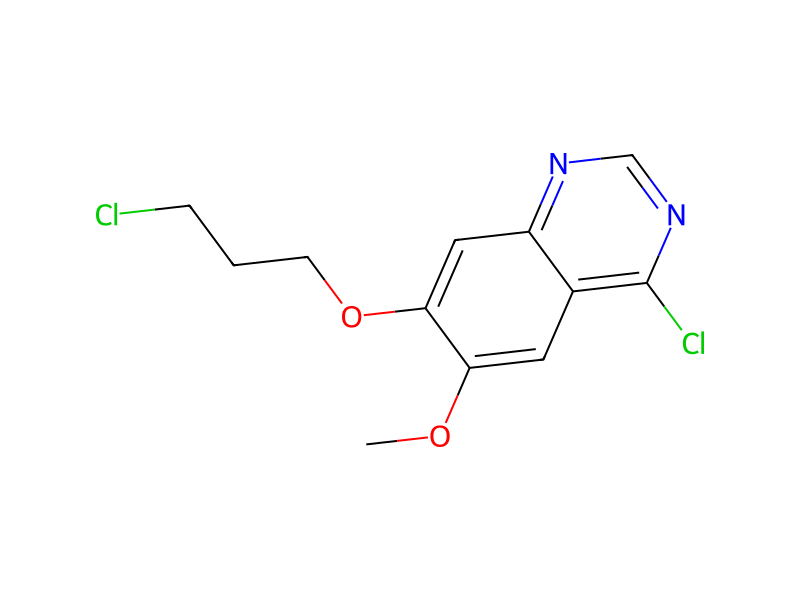
[Cl:1][CH2:2][CH2:3][CH2:4][O:5][C:6]1[CH:15]=[C:14]2[C:9]([C:10](O)=[N:11][CH:12]=[N:13]2)=[CH:8][C:7]=1[O:17][CH3:18].P(Cl)(Cl)([Cl:21])=O>C1(C)C=CC=CC=1>[Cl:21][C:10]1[C:9]2[C:14](=[CH:15][C:6]([O:5][CH2:4][CH2:3][CH2:2][Cl:1])=[C:7]([O:17][CH3:18])[CH:8]=2)[N:13]=[CH:12][N:11]=1Participants
4
Reactant 2


Product 1
Reagents, catalysts & solvents 1

Conditions
- Temperature
- 125 °C
Procedure
To a solution of the intermediate from Step 4 (3.00 g, 11.16 mmol) in toluene (30 mL) in a pressure vessel was added phosphorous oxychloride (8 mL). The mixture was heated to 125° C. for 5 hours. Completion of the reaction was monitored by LCMS. The mixture was concentrated to dryness and excess ethyl acetate was added. The solution was washed with water and brine and was dried (Na2SO4) and concentrated to afford the pure compound 4-chloro-7-(3-chloro-propoxy)-6-methoxy-quinazoline (2.51 g, 78%) as a yellow solid. 1H NMR (300 MHz, DMSO-d6) δ 8.85 (s, 1H), 7.48 (s, 1H), 7.35 (s, 1H), 4.35 (t, 2H), 4.00 (s, 3H), 3.75 (t, 2H), 2.25 (q, 2H). LC-MS (ESI)m/z 287 (M+H)+.
Workup
- concentrationThe mixture was concentrated to dryness and excess ethyl acetate
- additionwas added
- washThe solution was washed with water and brine
- dry with materialwas dried (Na2SO4)
- concentrationconcentrated
Sources & evidence
- ORD record
- ord-bd76335f28a84b6c96c4d33b08f4f83e
- Source dataset
- uspto-grants-2016_04
- Patent number
- US09320739B2
Linked notes
Loading…