Reaction equation

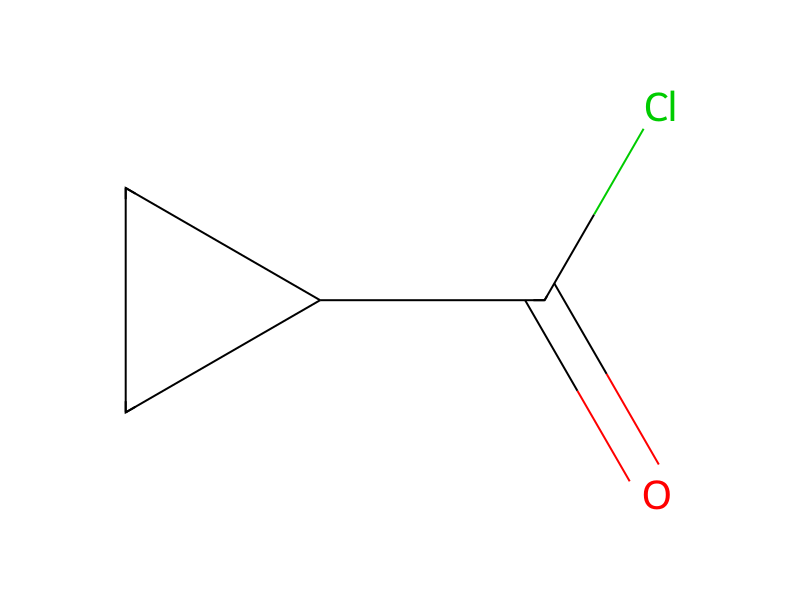
[NH2:1][C:2]1[S:3][C:4]2[CH:10]=[C:9]([S:11][C:12]#[N:13])[CH:8]=[CH:7][C:5]=2[N:6]=1.[CH:14]1([C:17](Cl)=[O:18])[CH2:16][CH2:15]1>N1C=CC=CC=1>[CH:14]1([C:17]([NH:1][C:2]2[S:3][C:4]3[CH:10]=[C:9]([S:11][C:12]#[N:13])[CH:8]=[CH:7][C:5]=3[N:6]=2)=[O:18])[CH2:16][CH2:15]1Participants
4
Reactant 2

Product 1

Reagents, catalysts & solvents 1

Procedure
The 2-[(cyclopropylcarbonyl)amino]-1,3-benzothiazol-6-yl thiocyanate was prepared in a manner similar to the method described in Example 18b, but using 2 g of commercial 2-amino-6-thiocyanatobenzothiazole and 1.21 g of cyclopropanecarboxylic acid chloride in 20 cm3 of pyridine after reaction for 5 h at 20° C. 2.65 g of 2-[(cyclopropylcarbonyl)amino]-1,3-benzothiazol-6-yl thiocyanate are thus obtained in the form of a yellow powder, the characteristics of which are as follows:
Workup
- customThe 2-[(cyclopropylcarbonyl)amino]-1,3-benzothiazol-6-yl thiocyanate was prepared in a manner similar to the method
- customafter reaction for 5 h at 20° C
Sources & evidence
- ORD record
- ord-512e6b498c194df7aaec06b9dfc6a581
- Source dataset
- uspto-grants-2016_04
- Patent number
- US09321777B2
Linked notes
Loading…