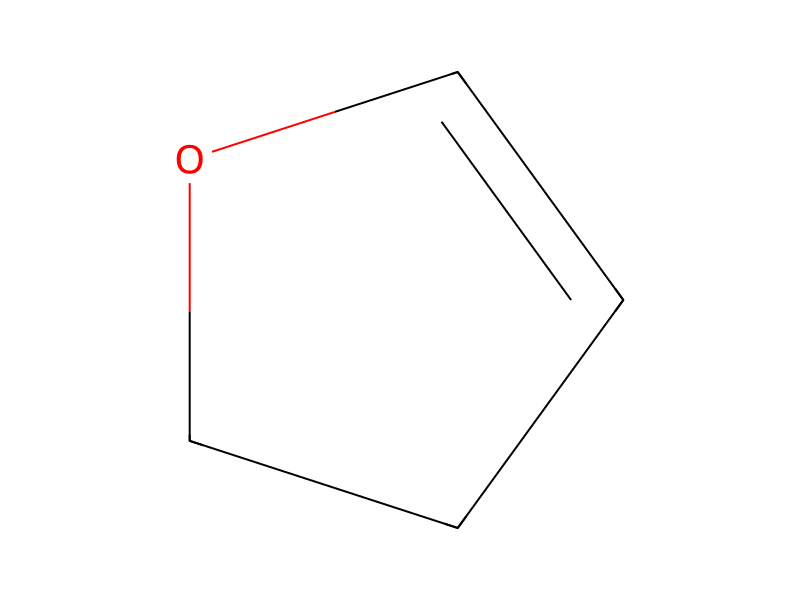
To a nitrogen-purged, 5000-mL, three-neck, round-bottom flask equipped with a bottom stopcock, thermometer, mechanical stirrer, addition funnel and ice bath was charged 330.0 g (4.70 moles) of 2,3-dihydrofuran, 391 g (4.95 moles) of pyridine, and 1000 mL of n-heptane. The mixture was cooled to 10° C. then trichloroacetyl chloride (500 mL, 815 g, 4.48 moles) was added dropwise from the addition funnel. An ice bath was used to hold the reaction mixture at 11 to 220° C. during the 190 minute addition. The resulting yellow slurry was stirred at 22 to 28° C. for 45 minutes. To the mixture was added 700 mL of 10% aqueous HCl. After stirring to dissolve the solids, the lower (aqueous) layer was separated and discarded. The organic layer was washed sequentially with 500 mL of 10% HCl, 250 mL of 5% aqueous sodium bicarbonate and finally with 250 mL of water. The solution was placed in a 3000-mL, three-neck, round-bottom flask equipped with a magnetic stirrer, thermowell/thermocouple, heating mantle, and 12-inch Vigreux distillation head. The mixture was heated under vacuum (130 mm) to distill off the water/heptane azeotrope then most of the heptane. The mixture was distilled to a pot temperature of 102° C. (head temperature was 50° C.). A total of 1135 mL of distillate was collected. The resulting crude 2,3-dihydro-4-trichloroacetylfuran (881.38 g, theory 965.26 g) was 98.4% assay by nuclear magnetic resonance (NMR) (89.8% assay-yield). The crude product was used directly in the following example.