HomeMCPWorkbenchSkills
HomeWorkbenchNotificationsMe
llms.txt · MCP GuidePrivacy Policy · Terms of Service · Supportv1.8.0
  1. Home
  2. /Reaction

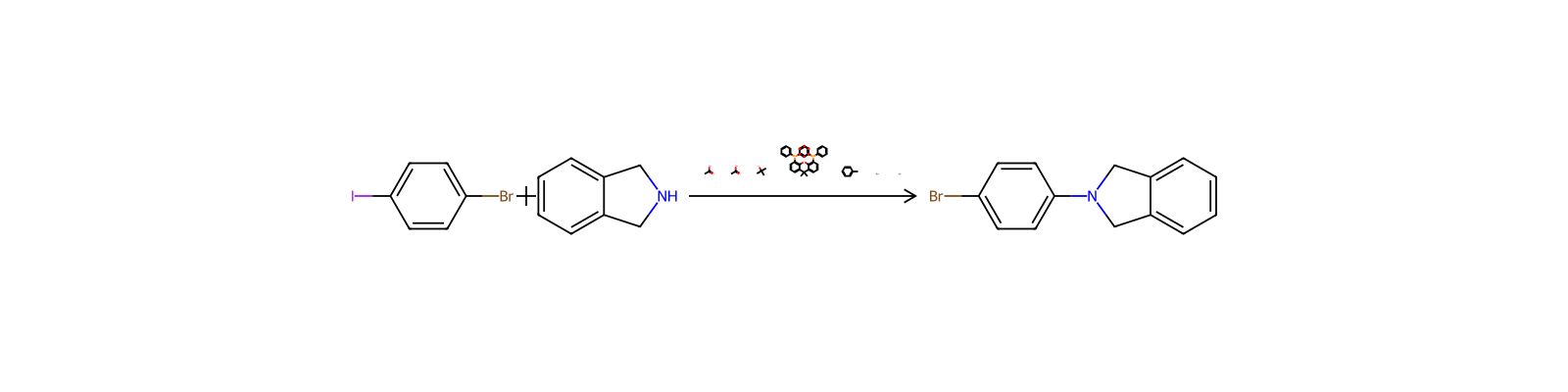
1-Bromo-4-iodobenzene → 2-(4-Bromophenyl)-1,3-dihydroisoindole

HRID 644
Notes
Print preview

Reaction equation

HRID 644 reaction equation
Brc1ccc(I)cc1.c1ccc2c(c1)CNC2>CC(=O)O.CC(=O)O.CC(C)(C)[O-].CC1(C)c2cccc(P(c3ccccc3)c3ccccc3)c2Oc2c(P(c3ccccc3)c3ccccc3)cccc21.Cc1ccccc1.[Na+].[Pd]>Brc1ccc(N2Cc3ccccc3C2)cc1
ParticipantsConditionsProcedureSources & evidenceReaction notes

Participants

7

Reactant 2

HCID 115221-Bromo-4-iodobenzeneHCID 422478Isoindoline

Product 1

HCID 37138782-(4-Bromophenyl)-1,3-dihydroisoindoleYield 48.3%

Reagents, catalysts & solvents 4

HCID 23676156Sodium t-butoxideReagentHCID 6360441,1'-(9,9-Dimethyl-9H-xanthene-4,5-diyl)bis(1,1-diphenylphosphine)Catalyst
HCID 4144353
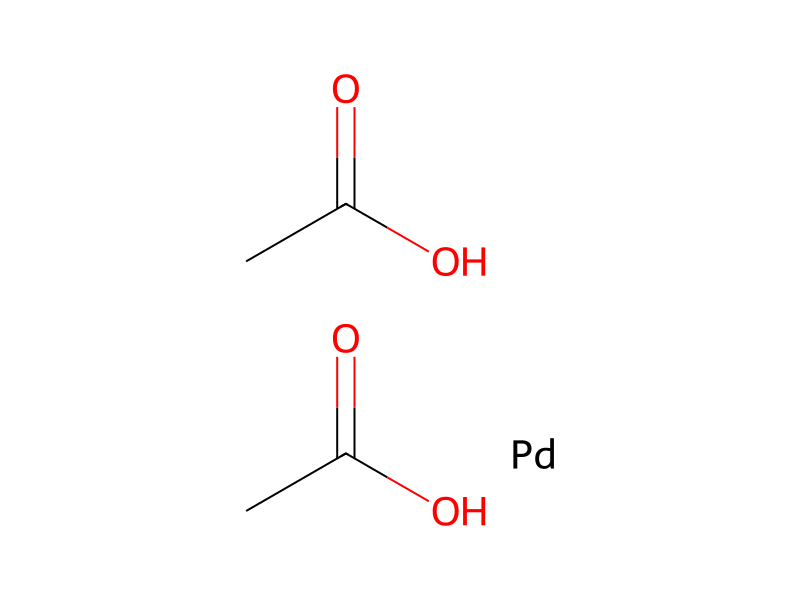
Palladium (II) acetate
Catalyst
HCID 1140TolueneSolvent

Conditions

Temperature
100 °C

Procedure

palladium(II) acetate (0.112 g, 0.50 mmol) and XANTPHOS (0.288 g, 0.50 mmol) were added to a degassed solution of isoindoline (0.566 ml, 4.98 mmol), 1-bromo-4-iodobenzene (1.41 g, 4.98 mmol) and SODIUM TERT-BUTOXIDE (1.197 g, 12.46 mmol) in toluene (49.3 ml) under nitrogen. The resulting solution was stirred at 100 °C for 18 hours. The reaction mixture was allowed to cool to RT and was partitioned between EtOAc and H2O, filtered and the organic layer separated and dried over MgSO4, filtered and evaporated to dryness to give crude product. The crude product preabsorbed onto SiO2 and was purified by flash silica (40g, grace) chromatography, elution gradient 0 to 10% DCM in heptane. Pure fractions were evaporated to dryness to afford 2-(4-bromophenyl)isoindoline (0.660 g, 48.3 %) as an orange solid.
Sources & evidence

ORD record
ord-be64b42a88614cc79bed55017a7f5289
Source dataset
750 AstraZeneca ELN dataset
Original link
View source

Reaction notes

Loading…

On this pageParticipantsConditionsProcedureSources & evidenceReaction notes